
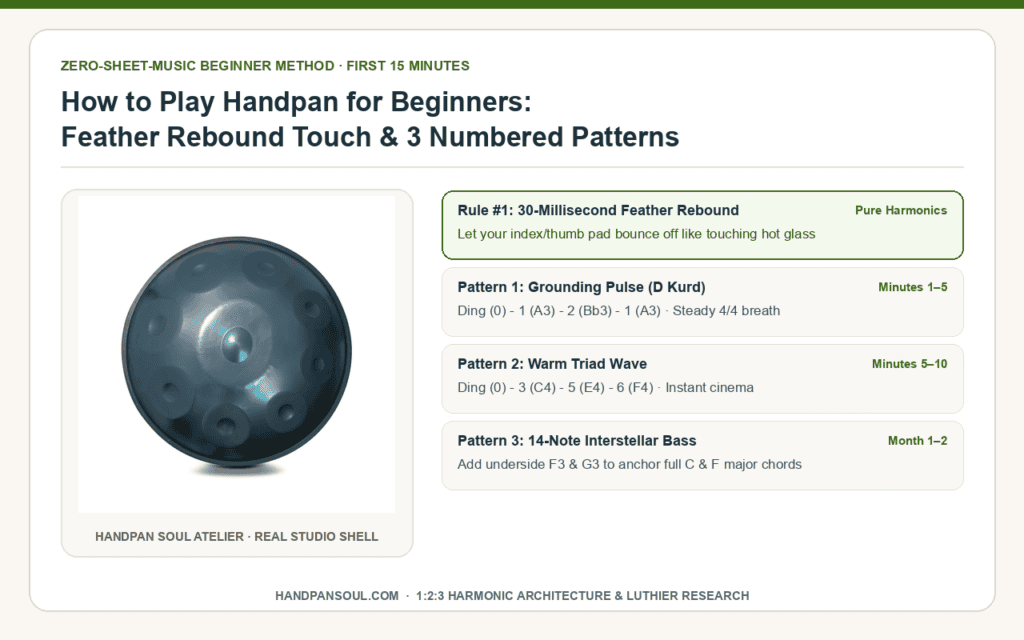
A handpan rewards speed of release, never force of impact. Think of testing whether a cast-iron skillet is warm: flick the outer tonefield ring (just outside the central dimple) with a relaxed index-finger pad or thumb edge and clear the steel within a ~20 ms visual coaching window. Because every note on a D Kurd handpan belongs to one diatonic minor family, complete beginners play flowing melodies in 15 minutes without reading sheet music.
More than 70% of Handpan Soul players open their case with zero prior background on piano, guitar, or drums. Bowed strings and fretted instruments demand months of intonation drills and finger calluses before a single chord sounds clean. On a hand-tuned handpan, harmonic intervals are forged directly into the steel geometry—leaving only one physical skill to learn in Week 1: letting the shell ring freely.
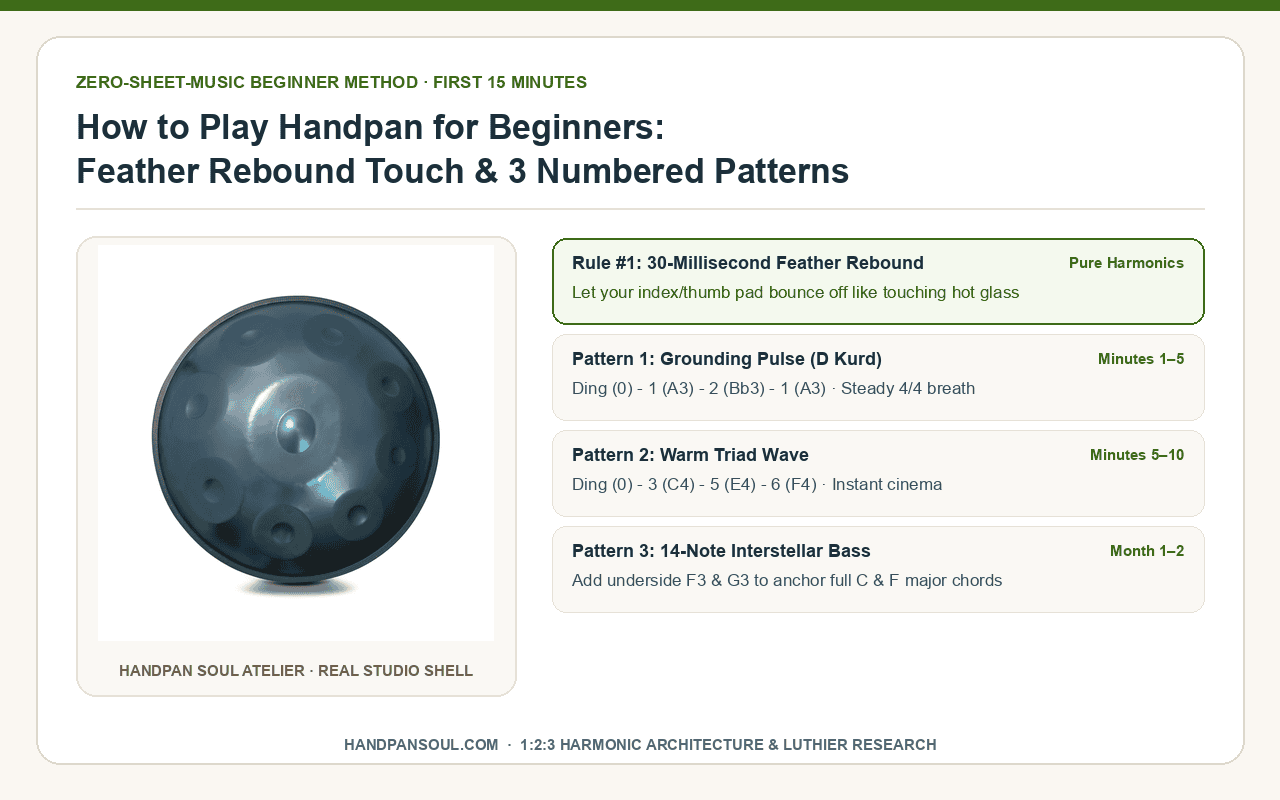
1. How Handpan Number Notation Works (Alternating Left-Right Zig-Zag)
Rather than five-line staff notation, handpan educators map notes by ascending pitch. Sit with the lowest chorale notes closest to your waist (5 o’clock and 7 o’clock). While some tab systems write 0 or D for the center Ding, ring notes always climb 1 → 2 → 3 → 4 in a natural right-left-right-left zig-zag:
| Tab Symbol | D Kurd Pitch (ISO 16 A4 = 440 Hz) | Shell Position & Natural Hand Assignment |
|---|---|---|
| D (or 0) | D3 (146.83 Hz) | Center apex Ding dome — Right or Left Thumb / Middle finger |
| (B1) / (B2) | F3 (174.61 Hz) / G3 (196.00 Hz) | Underside bass domes on Handpan Soul 14-Note D Kurd (12+2) |
| 1 | A3 (220.00 Hz) | Bottom-right (5 o’clock) — Right Hand |
| 2 | Bb3 (233.08 Hz) | Bottom-left (7 o’clock) — Left Hand |
| 3 | C4 (261.63 Hz) | Lower-right (4 o’clock) — Right Hand |
| 4 | D4 (293.66 Hz) | Lower-left (8 o’clock) — Left Hand |
| 5 | E4 (329.63 Hz) | Upper-right (2 o’clock) — Right Hand |
| 6 | F4 (349.23 Hz) | Upper-left (10 o’clock) — Left Hand |
| 7 | G4 (392.00 Hz) | Top-right (1 o’clock) — Right Hand |
| 8 | A4 (440.00 Hz) | Top-left (11 o’clock) — Left Hand |
| 9 · 10 · 11 | C5 · D5 · E5 | 12 o’clock crown & upper mutant voices (10, 12 & 14-note models) |
When a new owner sends us a clip worried that a note “sounds short or thuddy,” 95% of the time the shell is in tune across 1:2:3 partials—the culprit is fingertip linger. Try filming your hand from the side using your smartphone’s 240 frames-per-second (fps) slow-motion camera. At 240 fps, each video frame equals 4.17 milliseconds, so five frames equal 20.8 ms.
We use that five-frame (~20 ms) window as a practical visual coaching ceiling for the whole touch-and-release gesture (actual steel contact on a crisp strike is even briefer). When a beginner presses into the dimple for 15 to 24 frames (60–100 ms), skin mass damps the 1f fundamental before the 2f octave and 3f twelfth can couple. Equally common: resting your non-playing palm lightly on the opposite side of the shell silently chokes neighboring resonances.
2. Beginner Tone Diagnostic & Troubleshooting Matrix
| Audible Symptom | Physical Root Cause | 30-Second Self-Check | Corrective Practice Drill |
|---|---|---|---|
| Short, dry “thud” with weak sustain | Finger pad stays on the tonefield too long or uses too much flat flesh | Film at 240 fps; count frames from touch to clear | Flick upward from the knuckle joint as if brushing a hot pan; 20 feather-light reps per note |
| Thin, metallic high ring without warm bass | Striking dead-center inside the stiffened dimple or directly on a modal node | Move strike point outward in 5 mm steps toward the oval shoulder | Aim for the smooth elliptical ring midway between dimple edge and tonefield border |
| Adjacent notes die suddenly mid-phrase | Non-playing wrist, forearm, or thigh resting against active upper/lower shell | Play one note with eyes closed and lift the opposite hand completely away | Hover wrists 3–4 cm above the rim; place dual-shell pans on the included tripod stand |
| Harsh “zing” or pitch warble on loud hits | Swinging downward from the elbow, overdriving thin 1.05 mm steel | Watch elbow height in a mirror; listen at half force | Generate 90% of motion from relaxed finger flexion and gentle wrist rotation |
| Ascending tab sounds scrambled | Playing clockwise around the circle instead of alternating left-right | Check pitch order against the table above (1=A3, 2=Bb3, 3=C4) |
Practice slow R – L – R – L zig-zag walks from 1 up to 8 and back down |
| Wrist fatigue after 15 minutes | Locked wrist or pan positioned too high above navel level | Check shoulder tension and elbow angle (>90° relaxed slope) | Lower stand height and shake hands loose every 5 minutes |
3. Four Playable Beginner Patterns & Song Tabs (Try Today)
Count steady eighth notes out loud (1 & 2 & 3 & 4 & at 65 BPM). A hyphen (-) lets the note bloom; a plus sign (2+4) taps two notes simultaneously as a dyad; • denotes a whisper-soft ghost tap on the non-tuned rim space.
Pattern 1: The Breathwork Triad Pulse (Fits 9, 10, 12 & 14-Note D Kurd)
Beat:   1   &   2   &   3   &   4   &
Bar 1:  D   •   1   4   6   4   1   •    (D minor root grounding)
Bar 2:  2   •   4   6   8   6   4   •    (Bb major cinematic lift)
Bar 3:  3   •   5   7   8   7   5   •    (C major open horizon)
Bar 4:  D   •   4   5   6   4   1   -    (Calm resolution home)
Pattern 2: Hypnotic 6/8 Waltz Arpeggio (Solo Meditation Flow)
Count:  1   2   3   4   5   6
Bar 1:  D   1   4   8   4   1
Bar 2:  2   4   6   9   6   4     (On 9-note models, play 8 in place of 9/C5)
Bar 3:  6   3   6   8   6   3     (F major warmth)
Bar 4:  5   1   5   7   5   1     (E/A gentle cadence back to D)
Pattern 3: Fingerstyle “Tak” Backbeat Groove
Tap T crisp and light with your index pads on the stiff interstitial shoulder near 4 o’clock:
Count:  1   &   2   &   3   &   4   &
Loop:   D   •   4   •   T   1   6   4
Pattern 4: The Interstellar Bass Progression (Why 14-Note 12+2 Unlocks Soundtrack Harmony)
Cinematic progressions rely on F3 (B1) and G3 (B2)—the exact two sub-chordal bass voices placed ergonomically on the underside of our 14-Note D Kurd:
Phrase A (Bb):    2+4    8   4   8    2+4    8   4   8
Phrase B (F/G): (B1)+3   8   5   8  (B2)+4   8   7   8
Phrase C (Dm):    D+6    8   6  10    D+4    8   5   4
4. Seated Lap Posture vs. Wooden Tripod Stand Ergonomics
Your sitting posture shapes both tone clarity and wrist comfort. On compact single-shell 9-to-10-note instruments, sitting cross-legged on a low meditation cushion or upright on an armless chair works well—just keep your knees slightly parted so the underside Gu port breathes into open air rather than pressing flat against fabric. On extended dual-shell instruments such as our 14-Note (12+2) and 16/19-Note Master, resting the rubber rim on the included solid-wood tripod stand at navel height keeps every underside bass dome (F3, G3) completely unhindered while maintaining a relaxed downward forearm slope.
5. Frequently Asked Questions
What do the numbers in handpan tabs mean?
Beginner handpan tabs assign D (or 0) to the central apex Ding dome and number the surrounding tonefields 1, 2, 3, and upward in ascending pitch. Because handpan layouts alternate low-to-high across the right and left sides, playing 1-2-3-4 traces an ergonomic right-left zig-zag rather than a clockwise circle.
How hard should a beginner strike a handpan?
Use the lightest relaxed fingertip tap that activates a full harmonic bloom, clearing the surface immediately (within roughly five frames at 240 fps slow motion). If a note sounds quiet or dull, adjust your strike point toward the smooth oval shoulder ring around the dimple rather than hitting harder.
Should I stick paper number labels onto my handpan tonefields?
Avoid leaving adhesive stickers on tonefields—glue residue slightly damps upper partials and can trap moisture on Nitrided Steel. Prop our included 7-Day Printed Map Card in front of your stand; spatial muscle memory locks in all note positions within 3 to 5 short sessions.
How long does it take to learn to play a handpan?
Most beginners play their first steady four-bar meditation pattern within 15 to 30 minutes on Day 1. Practicing 15 focused minutes daily builds clean two-handed independence, ghost-note grooves, and effortless improvisation over the first 4 to 8 weeks.
Primary Acoustic & Motion-Analysis References
- Wessel, D., Morrison, A., & Rossing, T. D. (2008). “Sound of the HANG.” Proceedings of Meetings on Acoustics (POMA), 4, 035002. doi:10.1121/1.3068630
- Dahl, S. (2011). “Striking Movements: A Survey of Motion Analysis of Percussionists.” Acoustical Science and Technology, 32(5), 168–173. doi:10.1250/ast.32.168
- International Organization for Standardization (1975, confirmed 2022). ISO 16:1975 — Acoustics: Standard Tuning Frequency (Standard Musical Pitch, A4 = 440 Hz). iso.org
Practice These 4 Patterns in Your Browser Right Now — Free
Open our interactive 14-Note D Kurd Studio Simulator to tap D, A3–E5, and underside F3/G3 with authentic studio samples—plus get our 7-Day Beginner Roadmap in every box.
Open the Free Interactive Simulator →