
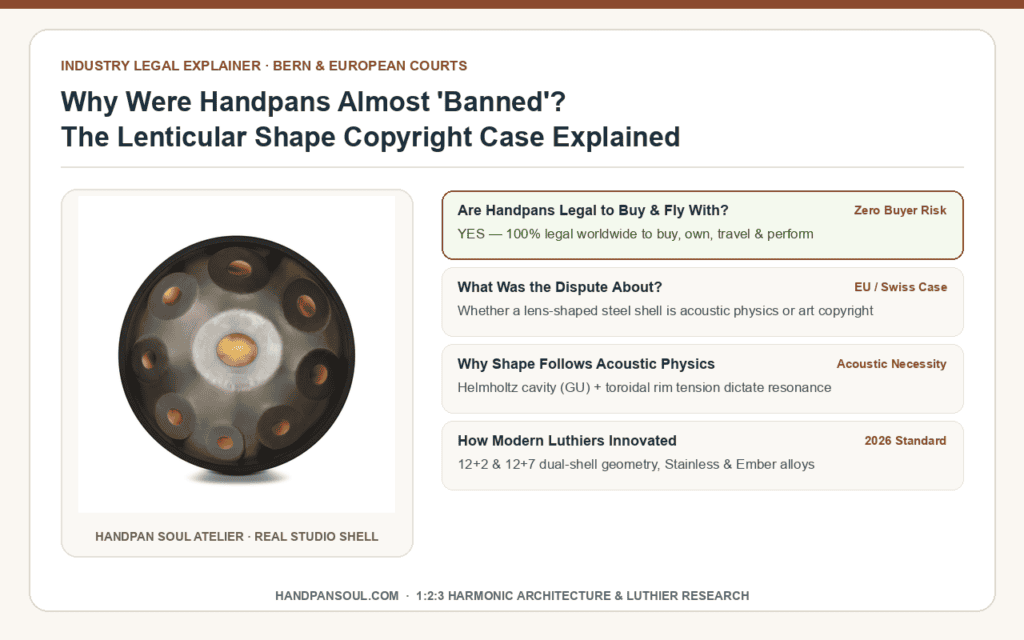
Two events seven years apart are frequently conflated online: first, in December 2013, Swiss creators Felix Rohner and Sabina Schärer (PANArt Hangbau AG) voluntarily ended sales of the classic Hang® to dedicate their Bern workshop to the Gubal® and Pang® ensemble instruments—no lawsuit caused production to end. Second, beginning in 2020, declaratory proceedings before the Commercial Court of the Canton of Bern (Case HG 20 117, with milestones in July 2024 and June 2026) examined how European copyright of applied art applies to close visual designs under specific national laws, alongside exceptions and procedural limits.
Editorial & Legal Boundary: This article summarizes publicly documented musicological history and European court milestones for general educational context and is not legal advice. Hang®, Gubal®, and Pang® are registered trademarks of PANArt Hangbau AG.
Few acoustic instruments of the twenty-first century carry an origin story as widely discussed—or as frequently misreported on social media—as the handpan. Separating the 2013 acoustic research shift from the 2020s European court filings clarifies both the creative history in Bern and how modern dual-shell luthiers engineer instruments today.
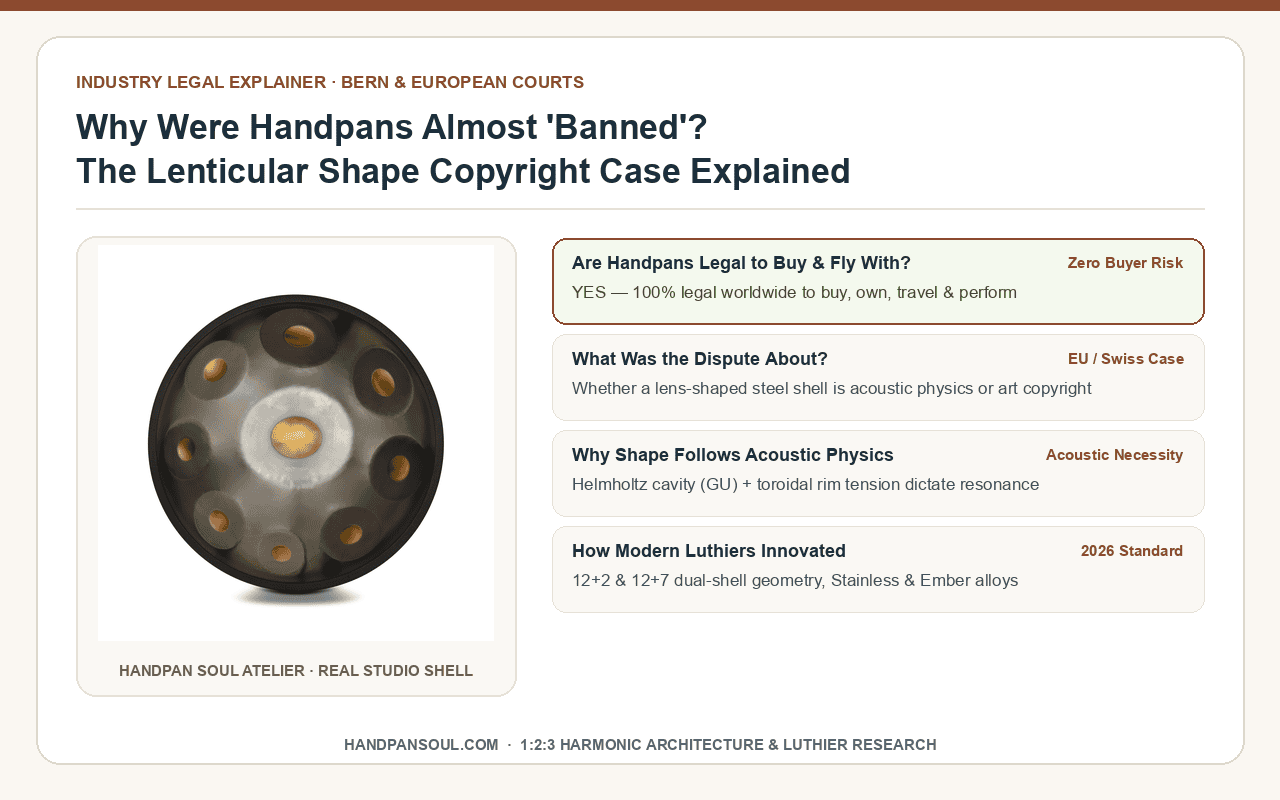
1. Why Hang Sales Actually Ended in December 2013 (Research Over Mass Factory Output)
Throughout the 2000s, Rohner and Schärer operated the Hangbauhaus in Bern as an experimental acoustic atelier rather than an industrial percussion factory. Buyers wrote physical letters and traveled to Switzerland in person as the builders refined First Generation scales (2001–2005), Second Generation brass-rimmed shells (2006–2007), the Integral Hang (2008), and the Free Integral Hang (2010).
As documented in PANArt’s 2014 monograph From the Hang to the Gubal and reported by SWI swissinfo.ch, the inventors sought a stronger, dynamic bass pulse by adding a hemispherical vessel extension (“Gugel”) and elastic ring around the Gu neck. In December 2013, PANArt announced that no further Hangs would be built so the team could devote full energy to the Gubal® and subsequent Pang® instruments.
2. Chronological Matrix: Acoustic History & Bern Court Milestones (2000–2026)
| Date | Documented Milestone | Primary Record | Accurate Meaning for Musicians & Buyers |
|---|---|---|---|
| 2000–2001 | Hang® developed in Bern and unveiled at Frankfurt Musikmesse (2001) | Rohner & Schärer (ISMA 2007) | Use Hang® strictly for PANArt’s Bern sculptures; use handpan for the general instrument category |
| Dec 2013 | PANArt concludes Hang sales to focus on the Gubal® | PANArt (2014) · SWI swissinfo.ch | Voluntary artistic and acoustic evolution—unrelated to the litigation that began seven years later |
| Oct–Dec 2020 | Cease-and-desist notices followed by declaratory actions filed in Bern by ~25 makers/dealers | Bern Commercial Court docket (HG 20 117) |
Tested whether lens-shaped geometry falls solely under expired technical patents or European applied-art copyright |
| 2 July 2024 | Phase-1 interim judgment on copyright eligibility of specified Hang® versions | Handelsgericht Bern, HG 20 117 |
Addressed threshold copyright protectability under Swiss, German, and Dutch law; did not issue a blanket global ban on players |
| 16 June 2026 | Phase-2 assessment of specific instruments submitted in the declaratory action (with exceptions) | Handelsgericht Bern, HG 20 117 (party-published German text) |
Applies to the named parties, examined designs, and jurisdictions in that proceeding (subject to applicable appeal windows) |
From a purely physical standpoint on our bench (making no legal claim—design clearance and acoustic engineering are distinct disciplines), a dual-shell handpan behaves as a coupled mechanical-air system. Before the upper and lower hemispheres are bonded, an unjoined top shell sits several cents sharper at the central Ding than its finished state because closing the 18-to-23-liter internal air volume loads the membrane and establishes the ~78–86 Hz Helmholtz Gu resonance.
When modern luthiers add bottom-shell tonefields—such as F3 and G3 on our 14-Note D Kurd (12+2) or seven underside voices on our 19-Note Master Concert—impedance matching across the polyurethane seam becomes critical so top and bottom octaves reinforce rather than cross-modulate each other. That is also why we advise players never to press the bottom Gu port into a thick sofa cushion while testing tuning.
3. Acoustic Prior Art vs. Design Appearance: How Physics Shapes Steel Shells
Why do handpans, Trinidadian steelpans, and clay pot drums share specific geometric traits? In musical acoustics, several dimensions of a hand-played harmonic vessel follow physical boundary laws documented decades before 2000, while aesthetic finishing details remain distinct variables:
| Structural Feature | Acoustic Boundary Requirement | Documented Pre-2000 Musical Precedent |
|---|---|---|
| Circular Dished Vessel (~52–58 cm) | Symmetric radial hoop stress prevents uneven buckling under kiln heat cycles while fitting human arm reach | Caribbean 55-gallon steelpans (1940s–1990s) & industrial dished pressure-vessel heads |
| Elliptical Tonefield (~4:5 Axis Ratio) | Orthogonal long and short axes separate the 2f longitudinal octave from the 3f transverse twelfth mode |
Published steelpan modal interferometry studies (Rossing, Hampton, & Hansen, 1980s–1990s) |
| Central Stiffening Dimple | Controls local bending stiffness so fundamental 1f aligns numerically beneath 2f and 3f |
Convex/concave bossed gong domes across Indonesian gamelan & Asian bronze traditions |
| Enclosed Air Cavity + Bottom Neck | 18–23 liters of enclosed air coupled to an aperture generates a ~78–86 Hz Helmholtz bass resonance | South Indian clay Ghatam & Nigerian Udu pot percussion instruments |
At the same time, European courts noted that acoustic function and applied-art copyright evaluate different questions: altering a musical scale or steel alloy does not by itself decide visual similarity under national copyright statutes, which is why contemporary ateliers invest in their own recognizable shell finishes, multi-note dual-shell layouts, laser-engraved maker emblems, and transparent studio documentation.
4. Three Ways Modern Handpan Engineering Evolved Over the Last Decade
- Corrosion-Resistant Stainless & Collector Ember Metallurgy: Early carbon-steel shells required frequent oiling and decayed with a brief, dry percussive pulse. Modern Crafted Stainless Steel (lingering chapel bloom) and Collector Ember Steel (deep velvety resonance) opened long, overlapping harmonic tails for solo composition and coastal studios.
- Multi-Octave Dual-Shell Layouts (12+2 to 12+7): Contemporary concert builders expanded pitch span from 7–8 single-sided notes up to full 2.5-octave
D3–A5arrangements playable on a tripod stand—allowing composers to voice true root-third-fifth bass progressions that were impossible on 8-note single-sided shells. - Ensemble Pitch Consistency: Studio musicians can collaborate seamlessly with cellos, pianos, and DAWs at
ISO 16 A4 = 440 Hz, or commission dedicated solo 432 Hz Sanctuary shells, hand-tuned and checked note-by-note before dispatch.
5. Practical Guidance for Buyers & Performing Musicians Today
For everyday players, teachers, yoga facilitators, and touring recording artists, three practical takeaways keep your purchase straightforward and respectful of every builder’s craft:
- Buy Transparently Named Instruments Direct From Known Ateliers: Choose builders who sign their own work, state their exact steel metallurgy and
A4reference pitch, and film your serial-numbered instrument before shipping. - Match Layout to Musical Repertoire, Not Nostalgia: If you want fast, dry percussive grooves reminiscent of early 2000s street recordings, audition Warm Nitrided DC04; if you want lush chordal sustain for modern solo pieces or breathwork, choose Crafted Stainless ★ or Collector Ember Steel.
- Use Accurate Terminology in Your Credits: Credit your instrument as a handpan (plus scale and maker) on album liner notes, YouTube titles, and workshop flyers—preserving historical accuracy while celebrating modern luthier craftsmanship.
6. Frequently Asked Questions
Did PANArt stop making the Hang because of a lawsuit?
No. PANArt announced in December 2013 that it had ceased producing the Hang in order to focus its Bern workshop on the Gubal® and Pang® ensemble instruments. The European copyright litigation began in 2020—roughly seven years after Hang sales had already ended.
Did European courts ban owning or playing handpans worldwide?
No. Private ownership, air travel, street busking, teaching, and commercial studio recording on handpans remain completely unrestricted for musicians. The Bern Commercial Court proceedings (HG 20 117) addressed applied-art copyright claims between named commercial parties under specific European national laws.
Why do ethical luthiers never put “Hang Drum” in product names?
Hang® is the registered trademark of PANArt Hangbau AG. Ethical independent ateliers sign instruments under our own studio name and warranty so buyers know the exact maker, alloy, and tuning specification they are purchasing.
How do dual-shell 14-note and 19-note handpans differ acoustically from early 8-note shells?
Dual-shell builds place sub-chordal bass domes (such as F3 and G3) and high mutant voices on the bottom hemisphere, expanding melodic range up to 2.5 octaves while preserving generous finger spacing on the 12-note top shell.
Primary Historical, Acoustic & Public Court Sources
- PANArt Hangbau AG (2014). “From the Hang to the Gubal.” Official Bern historical chronology. panart.ch
- Handelsgericht des Kantons Bern (Commercial Court of the Canton of Bern). Case
HG 20 117, Interim Decision of 2 July 2024 & Decision of 16 June 2026 (published summaries/texts via party disclosures). - Rossing, T. D., Morrison, A., Hansen, U., Rohner, F., & Schärer, S. (2007). “Acoustics of the HANG: A hand-played steel instrument.” Proceedings of ISMA 2007, Barcelona.
Explore Modern Hand-Tuned Dual-Shell Handpans
Compare 9-note portable shells, our 14-note (12+2) sweet spot, and our 19-note concert flagship—each hand-tuned and checked note-by-note before dispatch.
Browse the Handpan Soul Atelier Collection →