
Rule 1 (Sweat Chemistry): Wipe finger oils off with a clean, dry microfiber cloth after every session—human eccrine sweat ranges from pH 4.0 to 6.9 with dissolved sodium chloride that attacks bare carbon steel if trapped. Rule 2 (Airflow): Never store any handpan zipped inside a soft padded bag at home; display it openly on a wooden tripod stand at 40%–60% relative humidity. Rule 3 (Alloy Schedule): Oil Warm Nitrided DC04 every 2–4 weeks indoors (weekly near coastal salt air), whereas Crafted Stainless ★ and Collector Ember Steel need only a light 4–8 week protective film.
A hand-hammered handpan has zero strings to snap, zero animal drumheads to slacken in monsoon weather, and zero active electronics to fail—so long as you guard thin tensioned steel against two physical threats: trapped chloride moisture and mechanical or thermal shock. Follow this workshop-verified protocol to keep your instrument clean, resonant, and in clean concert pitch for decades.
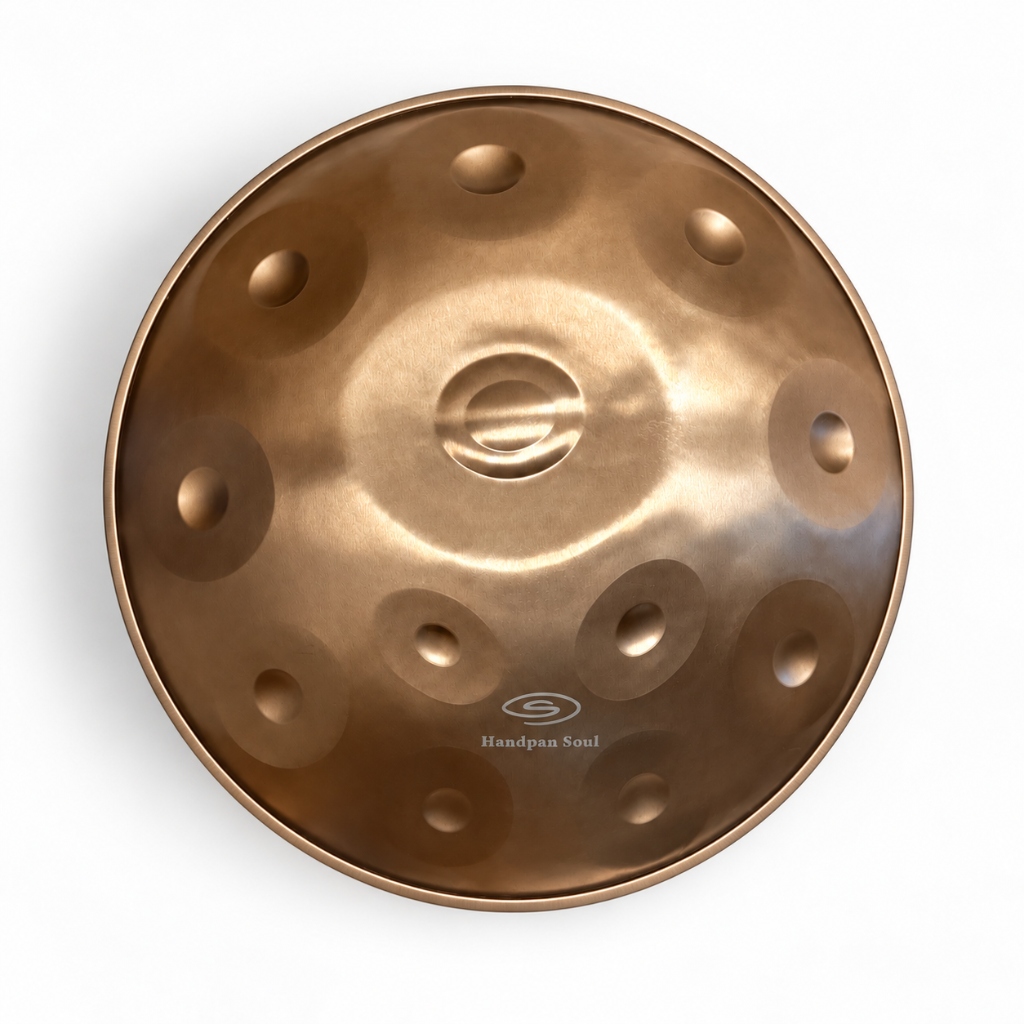
1. Why Sweat Chemistry & Closed Bags Cause 90% of Handpan Rust
Physiological sweat studies (Baker, 2019) show that human eccrine sweat exits skin ducts at roughly pH 4.0–5.0 during calm indoor playing and carries sodium, potassium, chloride ions, lactic acid, and urea. Even on corrosion-resistant stainless alloys, electrochemical research (Liu & Wang, 2025) demonstrates that concentrated acidic chloride droplets left undisturbed in humid, oxygen-depleted crevices challenge passive surface films over time—and on carbon-based Gas-Nitrided DC04, chloride salts rapidly initiate orange iron-oxide specks wherever the nitrided diffusion layer is microscopic.
Zipping a freshly played handpan inside a foam backpack creates a sealed micro-greenhouse around those exact fingerprints. Wiping the shell dry for ten seconds after playing and storing it openly on its wooden tripod stand eliminates that mechanism completely.
Two temperature phenomena surprise players traveling between winter streets, sunny beaches, and air-conditioned studios. First, Young’s modulus of elasticity in steel changes slightly with temperature (Achong, 1999): leaving a dark bronze or golden shell in direct midday sun heats the surface to 50–60°C, causing the notes to drop noticeably flat and sound unstable, whereas cold winter air shifts pitch slightly sharp. Never attempt to tune or judge an instrument while hot or icy—move it into room-temperature shade for 30 to 45 minutes and let the steel recover naturally (never pour cold water onto a sun-heated shell).
Second, when bringing a 56 cm Hard-Shell Flight Case indoors from a 5°C car trunk or aircraft hold into a warm, humid 22°C room, keep the case latched closed for 60–90 minutes. Opening an ice-cold steel shell immediately in warm indoor air condenses invisible water droplets across both hemispheres, including inside the bottom Gu cavity.
2. Care & Diagnostic Schedule by Steel Alloy and Environment
| Alloy or Situation | Microfiber Wipe | Inspection & Oil Interval | Immediate Action & Escalation Rule |
|---|---|---|---|
| Warm Nitrided DC04 (Indoor 40–60% RH) | After every session (mandatory) | Inspect weekly · Thin oil film every 2–4 weeks | Shorten to every 7–10 days after sweaty summer sessions; never leave in a zipped soft bag |
| Warm Nitrided DC04 (Coastal / >70% RH) | After every session | Inspect twice weekly · Oil every 7–14 days | Keep rechargeable silica-gel packs in travel case; for permanent beach homes, prefer Stainless ★ |
| Crafted Stainless Steel ★ (Chromium Passivated) | After every session | Inspect bi-weekly · Light oil every 4–8 weeks | Natural EN 10088 chromium-oxide film resists humidity; wipe clean after ocean air exposure |
| Collector Ember Steel (Heat-Treated Patina) | After every session | Inspect bi-weekly · Thin neutral oil every 4–8 weeks | Never use abrasive metal polish—it strips the intentional golden/bronze thermal oxide finish |
| First Tiny Orange Speck on Nitrided Steel | Immediate spot care | Test on inconspicuous rim edge first | Lift gently with 2 drops of handpan oil on a soft cloth; stop and contact our bench if near a tonefield |
| Commercial Airline / Winter Road Transit | Dry wipe + fresh thin oil before packing | Check before every itinerary | Allow closed flight case to equalize to room temperature before unlatching to prevent condensation |
3. Five-Step Cleaning & Oiling Routine (Under 5 Minutes)
- Play With Clean, Ring-Free Hands: Hand cream, reef sunscreen, sea salt, and metal rings are the leading causes of cosmetic marks and dimple scratches. Wash and dry hands before playing.
- Remove Old Sticky Oil Buildup Periodically: Layering fresh oil on top of dust and oxidized oil month after month builds a tacky film that damps upper partials. Wipe clean with a soft microfiber cloth lightly dampened with a maker-approved cleaner (avoid soaking the polyurethane rim seam or using household acids, vinegar, WD-40, or steel wool).
- Apply Only 4 to 6 Drops of Approved Handpan Oil: Use dedicated Phoenix Handpan Oil, fractionated coconut oil, or pure acid-free mineral oil—never culinary olive or vegetable oil, which polymerizes into a sticky resin.
- Coat Both Top, Bottom & Rim Edge: Spread a whisper-thin barrier across the Ding, tonefields, underside Gu port, and adjacent to the protective rim trim.
- Buff Completely Dry With a Second Clean Cloth: The finished shell should feel satin-dry to the touch, never wet or slick.
4. Flying With a Handpan: What U.S. DOT & International Airline Rules Actually Say
Many blogs claim a federal law “guarantees your handpan an overhead bin.” Read the official text carefully before heading to the airport: under U.S. Department of Transportation Final Rule 14 CFR Part 251 (80 FR 161), U.S. carriers must permit a small musical instrument in the cabin only if it safely fits approved overhead or under-seat stowage dimensions AND space is available when you board—airlines are not required to remove other passengers’ bags.
- Cabin Dimensions Reality: Because a full-size 53–56 cm handpan inside a rigid case exceeds standard 22 × 14 × 9 inch economy carry-on sizers on many narrow-body jets, always check your operating carrier’s musical-instrument policy, board in Group 1 priority when allowed, or purchase a cabin instrument seat for irreplaceable concert shells.
- Gate-Check & Hold Protection: Never fly with only a soft padded gig bag—one luggage conveyor drop onto the central Ding destroys tuning. Always pack inside an armored hard case with internal EVA foam suspension such as our Handpan Shield 56 cm Travel Pro Hard-Shell Flight Case (US$200), photograph both shells before travel, and remove loose stands or oil bottles from inside the case.
- Cabin Pressure Myth: Aircraft pressurization changes do not detune solid steel shells (unlike sealed wooden guitars with humidified tops), because the bottom Gu port equalizes air pressure instantaneously!
5. Seasonal Storage Checklist for Long Trips Away From Home
If you leave your instrument unplayed for four weeks or longer while traveling, spend three minutes preparing the shell so you return to spotless steel: degrease old fingerprints with a dry microfiber cloth, apply a fresh whisper-thin coat of approved handpan oil across both hemispheres and along the rim trim edge, buff dry, and rest the handpan on its wooden tripod stand in an interior room away from south-facing windows, radiators, or damp basement walls. Draping a breathable cotton dust cover loosely over the top dome keeps household dust off the steel without trapping humidity.
6. Frequently Asked Questions
How often should I oil a handpan?
Let steel alloy, sweat exposure, and room humidity set your clock: wipe dry with microfiber after every session, oil Warm Nitrided DC04 every 2 to 4 weeks indoors (every 1 to 2 weeks in humid or coastal air), and apply a thin protective coat to Crafted Stainless or Collector Ember Steel every 4 to 8 weeks.
Can I take a handpan on a commercial airplane?
Yes, provided it travels in a rigid hard-shell flight case and you verify your airline’s musical-instrument dimensions before departure. U.S. DOT rule 14 CFR Part 251 allows cabin stowage only when the case physically fits the bin and boarding space remains available, so always pack in a checked-safe 56 cm flight case in case gate-checking is required.
Why did my handpan sound out of tune in hot sunlight, and is it permanently damaged?
Direct sunlight rapidly heats steel to 50–60°C, temporarily lowering elastic tension so notes drift 10 to 30 cents flat. Do not strike hard or pour cold water on it—simply rest the instrument in cool indoor shade for 30 to 45 minutes and its tuning will settle back naturally as temperature equalizes.
Which handpan steel is best for Florida, Hawaii, UK, Singapore, or coastal homes?
Choose Crafted Stainless Steel ★ or Collector Ember Steel. Both alloys offer strong chromium-oxide corrosion resistance against humid salt air while delivering a bright, lingering harmonic bloom.
Primary Electrochemical, Acoustic & Aviation References
- Baker, L. B. (2019). “Physiology of sweat gland function: The roles of sweating and sweat composition in human health.” Temperature, 6(3), 211–259. doi:10.1080/23328940.2019.1632145
- Liu, T., & Wang, B. (2025). “Effect of pH on Corrosion Mechanism of Two Austenitic Stainless Steels in Artificial Sweat.” International Journal of Electrochemical Science, 20(8), 101065. doi:10.1016/j.ijoes.2025.101065
- Achong, A. (1999). “Non-linear Analysis of Compressively/Thermally Stressed Elastic Shell Structures on the Steelpan and the Underlying Theory of the Tuning Process.” Journal of Sound and Vibration, 222(4), 597–620. doi:10.1006/jsvi.1998.2064
- U.S. Department of Transportation, Office of the Secretary (2015). “Carriage of Musical Instruments.” Final Rule,
14 CFR Part 251, Federal Register, Vol. 80, pp. 161–166. transportation.gov
Protect Your Handpan in Any Climate or Cabin
Explore humidity-resistant Crafted Stainless & Collector Ember handpans—plus our 56 cm Travel Pro Hard-Shell Flight Case.
Browse Rust-Resistant Stainless & Flight Gear →