
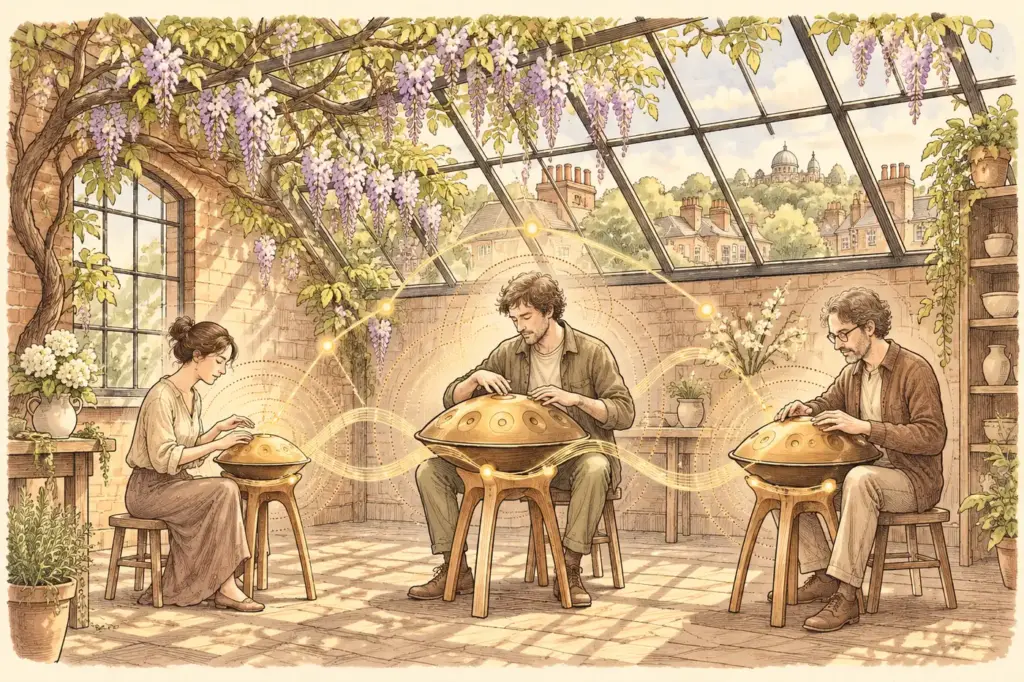
A handpan commonly has nine notes, counting the central note, but expanded layouts can have 12, 14, 19 or more. Count the tuned fields on both shells, then check where they sit: a 14-note handpan with 12 notes on top and two underneath plays differently from a layout that puts all its notes within reach from above.

How many notes does a handpan have, and what counts as one?
Start with the central note, usually called the Ding. Add the tuned fields around it, then turn the instrument over and count any tuned fields on the underside. A common nine-note layout has one Ding and eight surrounding notes. The underside opening, often called the Gu, is not normally part of that count. It contributes to the instrument’s air resonance and can be played percussively, but it is not counted as a conventional tuned field.
When comparing listings, ask for a pitch map rather than relying on the number in the title. Some makers describe a Ding and eight surrounding fields as “1+8,” and expanded instruments may list their top and bottom counts separately. A pitch map also tells you what the extra fields actually add. A higher D gives you another register without adding a new pitch class, while a note outside the original scale supplies a different melodic option.
One tuned field can produce several audible frequencies. Many handpan fields are tuned around a 1:2:3 relationship: the fundamental, its octave, and a compound fifth, which is a fifth above that octave. These are partials of one note field, not three separately playable notes. Other vibrational modes may also be present. That distinction matters when you look at a spectrum or when a tuner briefly reports an octave above the pitch you expected.
Comparing 9-note, 12-note, 14-note and 19-note layouts
Read this table as a guide to playing choices, not as a universal layout chart. Two instruments with the same count can put different pitches on top, use different registers, or require very different movements to reach the underside.
| Total notes | What to check | Practical reason to choose it |
|---|---|---|
| 9 | One Ding plus eight surrounding fields is common. | A compact map makes it easier to repeat a phrase while working on timing and touch. |
| 12 | Check whether all 12 are on top and which pitches extend the range. | More melody choices without an underside reach if the full layout is on top. |
| 14 | The featured D Kurd has 12 top notes plus F3 and G3 underneath. | Keep the main phrase on top and bring in lower notes when the arrangement calls for them. |
| 19 | Check the top and underside split and the spacing between frequently paired fields. | A larger palette is useful if your arrangements already call for specific pitches or register changes. |
Before buying, use the interactive handpan studio to sketch a short melody. Play it once with a small set of pitches, then add one lower or higher note. Notice whether the addition improves the phrase or simply gives you another place to land. The browser is useful for hearing pitch relationships, but it cannot tell you whether your hand clears the rim or whether a particular field feels comfortable at speed.
What the two underside notes add to the 14-note D Kurd
The 14-Note D Kurd Crafted Stainless gives you 12 playable fields on top, including the Ding, and two underside bass fields, F3 and G3. Those bottom notes give you lower-register options around the D center. Try placing F3 or G3 at the start of a measure, then returning to the top for the melody. If you can leave the bottom notes out and the phrase still works, you have a useful arrangement that can grow as your reach becomes more reliable.
On a physical instrument, sit in your normal playing position and keep the underside fields clear of your legs or stand. Play four slow measures on top, then add one underside strike without tilting the shell. Use a light bare-finger strike and let the finger rebound immediately. Leaving it on the field damps the vibration; hitting harder to compensate can bring out more attack noise. If you have to shift the instrument every time, try a different support position before assuming you need faster hands.
The 14-note D Kurd is US$1,290 in Nitrided, US$1,490 in Crafted Stainless, and US$2,490 in Ember Steel. The Wisdom 9-Note is US$990, the Mini Travelling G3 is US$890, and the D Kurd Master 16/19-Note is US$1,890. The Travel Pro Hard Case is an additional US$150 when bundled or US$200 standalone. Shipping is free by insured express air. DDP, with duties paid by the seller, applies only to the US, UK, EU, Switzerland and Norway.
How to check pitch, sustain and reach before choosing
- Check the pitch map against a recording. Ask for isolated strikes on each field, including the underside. A 48 kHz recording is ample for capturing the fundamental and the main tuned partials. For a useful comparison, keep microphone position and gain consistent. Sample rate alone cannot correct clipping, background noise or heavy processing.
- Listen past the attack. If you have the instrument in front of you, open the Handpan Soul browser tuner to check individual pitches. Let the previous note decay, strike the next one lightly, and watch for a stable reading after the initial transient. If it jumps to an octave, try another light strike before drawing a conclusion. A tuner reading is a pitch check, not a full assessment of the field’s partials.
- Compare at the tempo you actually play. Repeat the same short phrase with and without an underside note. Listen for an uneven gap, a muted bass strike, or a top note cut short by your reach. Use Phone Studio Practice in the browser studio to rehearse the pitches separately from the physical reach. Buyers also receive the free 7-Day Guided Course.
Frequently asked questions
Is nine notes enough for a beginner?
Yes. Nine well-chosen notes are enough to develop steady timing, clean strikes and complete musical phrases. Move up when you can name a pitch or register you keep missing, rather than because the larger count looks like a better value.
Does a 19-note handpan sustain longer?
No. Note count does not determine sustain. Field geometry, tuning, material and energy transfer between fields all influence how a strike decays. Compare individual notes at similar playing strength, then listen to how they behave in a phrase.
How can I confirm the layout before ordering?
Ask for the full pitch list with octave numbers and a clear top and underside split. Contact Handpan Soul at [email protected] or on WhatsApp at +44 7561 346554.