
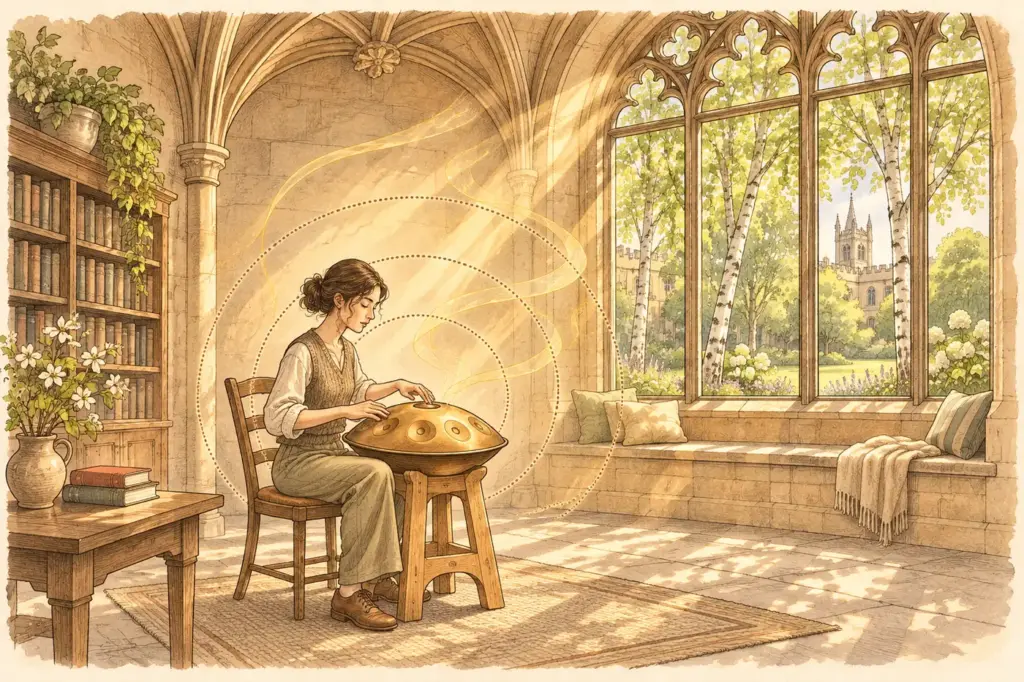
A handpan works by turning each hammered oval tone field into a small vibrating plate tuned to three partials at once: a fundamental, an octave above the fundamental (2x), and a compound fifth above the fundamental (a fifth above the octave, 3x), in a 1:2:3 frequency ratio. The two steel shells form a resonant air cavity that adds bass, and the dimple at the centre of each field controls pitch, stiffness and how cleanly the note separates from its neighbours.

The shell: two domes, one resonating cavity
A handpan is two shallow steel hemispheres bonded at the rim. The top shell carries the Ding, the raised central note, with a ring of tone fields around it. The bottom shell has the Gu, a round opening in its centre. On extended models such as our 14-Note D Kurd Crafted Stainless, the bottom shell also carries two extra bass fields, F3 and G3, alongside the 12 notes on top.
The air inside the shells and the Gu opening act together as a Helmholtz resonator, the same physics that makes a bottle hum when you blow across it. The cavity has its own resonant frequency, set by the internal volume and the Gu diameter. When a low tone field’s fundamental sits near that air resonance, the air couples to the steel and the note gains body and sustain. This is why a well-built pan sounds fuller in the low register than the steel alone could manage, and why changing the Gu size during a build shifts how the bass notes bloom.
When you press a palm over the Gu while playing, you detune that cavity. The bass changes in character and sometimes “wah” effects appear. Try it with a tuner open and you will see the low partials move. Our free browser tuner in the Handpan Soul Studio displays this live from your phone microphone.
Tone fields: why they are oval and what the dimple does
Each tone field is an area of steel that has been hammered so that it is under different tension from the surrounding shell. The hammering around the boundary compresses and stiffens the steel outside the field, which forms a frame. Inside that frame, the field can vibrate as a semi-independent plate. If the boundary is weak, energy leaks into neighbouring notes and you hear sympathetic ringing or a muddy attack.
The oval shape is deliberate. A circular field would give two of its vibration modes nearly identical frequencies, and they would be hard to separate and tune. An ellipse has a long axis and a short axis, which splits the modes apart so a tuner can adjust each one on its own:
- Fundamental: the whole field moves up and down as one piece.
- Octave: the field splits into two halves along its length, with a nodal line across the middle.
- Compound fifth: the field splits into two halves across its width, with a nodal line running lengthwise.
The dimple is the small dome in the centre of each field, pressed either inward or outward. It adds local stiffness, which raises the pitch and helps define the field. Its size, height and shape also affect how the energy is shared between the three modes. A larger dimple tends to belong to a lower note. When you play, striking just outside the dimple edge with a bare fingertip and lifting immediately gives the cleanest response. That quick rebound matters: a finger that stays in contact damps the field and kills the octave first, because the octave has its strongest movement away from the centre.
Triple harmonic tuning: the 1:2:3 ratio in practice
A struck metal plate does not naturally produce harmonic overtones. Its modes sit at irregular ratios, which is why an untuned sheet of steel sounds clangy. The tuner’s job is to pull the three main modes into a harmonic series. Take the D Kurd Ding at D3 as an example:
- Fundamental (1×): 146.83 Hz
- Octave (2×): 293.66 Hz, which is D4
- Compound fifth (3×): 440.49 Hz, close to A4
Note that a pure 3:1 ratio sits about 2 cents above an equal-tempered A4 at 440.00 Hz. We tune the fifth to the pure ratio relative to its own fundamental, because that is what makes the note sound settled. If the octave or fifth drifts away from its target, the partials beat against each other and the note sounds sour or “wobbly” in its decay even when the fundamental reads perfectly on a tuner.
Here is the workflow we follow at the bench when checking a finished note:
- Record each note at 48 kHz in a quiet room, struck with a bare finger at normal playing strength, and let it decay fully.
- Run a spectrum analysis and read the frequency of the three strongest peaks.
- Compare the fundamental to its equal-tempered target in cents.
- Compare the octave against exactly 2× the measured fundamental, and the compound fifth against exactly 3×.
- Strike neighbouring fields and listen for sympathetic ringing, which points to a weak boundary.
- Adjust with light hammer blows, then rest the shell and measure again, since steel settles after work.
You can run a simplified version of steps 2 to 4 at home. Open the Handpan Soul Studio tuner tab, play one note at a time, and watch whether the reading stays steady through the decay. A drifting needle on one note while the others hold still is often the first sign a field needs attention.
Comparing shell materials on the 14-Note D Kurd
Field geometry and tuning ratios stay the same across materials, but the steel changes how the note decays and how the instrument should be cared for. Here is how our three D Kurd 14-note builds compare:
| Build | Price | Sound character | Care |
|---|---|---|---|
| Nitrided steel | US$1,290 | Warm, rounded attack, moderate sustain | Wipe and apply a thin protective oil regularly, as the nitrided surface can corrode with sweat and humidity |
| Crafted Stainless | US$1,490 | Longer sustain, clear and bright upper partials | Highly corrosion resistant, needs a simple wipe-down after play |
| Ember Steel | US$2,490 | Our premium shell for players who want a distinct tonal colour | Wipe after play; ask us for current care guidance |
If you want a smaller entry point, the Mini Travelling G3 is US$890 and the Wisdom 9-Note is US$990. Players who need more range can look at the D Kurd Master 16/19-Note at US$1,890. A Travel Pro Hard Case adds US$150 when bundled with an instrument (US$200 on its own). Every order ships by free insured express air. Duties are seller-paid (DDP) only for the US, UK, EU, Switzerland and Norway; buyers elsewhere should expect local import charges.
Each instrument includes the free 7-Day Guided Course, plus Phone Studio Practice inside the Handpan Soul Studio, where you can check every note’s pitch on your phone.
Frequently asked questions
Why does my handpan note sound out of tune when the tuner says it is correct?
Most tuners read only the fundamental. If the octave or compound fifth has drifted from its 2× or 3× target, the partials beat and the note sounds off even though the main pitch is right.
Does how hard I strike change the pitch?
Very hard strikes can push a field beyond its stable range and cause a brief pitch bend or buzz. A light, quick bare-finger rebound near the dimple edge gives the most stable tone.
What does the Gu actually do?
It sets the air resonance of the cavity, which supports the low notes. On the 14-Note D Kurd, the F3 and G3 underside fields sit on the bottom shell next to it.
How can I contact you with tuning questions?
Email [email protected] or message us on WhatsApp at +44 7561 346554. Recordings made at 48 kHz help us diagnose a note quickly.