
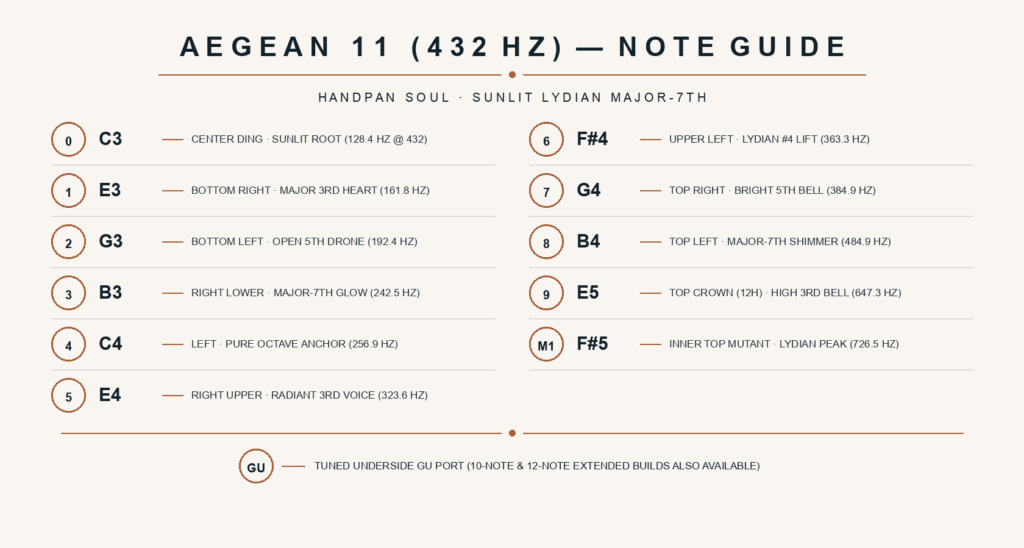
440 Hz (ISO 16 Concert Pitch) is the universal musical standard: choose 440 Hz if you ever wish to play alongside guitars, pianos, cellos, ukuleles, or standard backing tracks. 432 Hz Sanctuary Tuning shifts every note exactly −31.77 cents lower (about one-third of a semitone), creating a slightly mellower, warmer solo voice favored by 432 Hz crystal-bowl practitioners. Crucially, 432 Hz and 440 Hz instruments cannot play together in the same ensemble, and a steel handpan’s reference pitch cannot be toggled after forging.
Few topics generate more mystical claims—or practical buyer confusion—than 432 Hz vs. 440 Hz. As luthiers who hammer and hand-tune both standards every week, we skip numerology and give you the exact acoustic math, ensemble rules, and pricing facts so you never order the wrong reference pitch.
1. Exact Frequency Math: 440 Hz vs. 432 Hz Side-by-Side
Under logarithmic cent math introduced by Alexander J. Ellis (1885), shifting the reference pitch from A4 = 440.00 Hz (standardized internationally in ISO 16:1975) down to A4 = 432.00 Hz lowers every fundamental, octave, and twelfth across the shell by 1200 × log₂(432 / 440) = −31.77 cents:
| Note Degree | 440 Hz Concert Standard | 432 Hz Sanctuary Tuning | Acoustic & Ensemble Difference |
|---|---|---|---|
| C3 (Aegean Ding) | 130.81 Hz | 128.43 Hz | −2.38 Hz (−31.8¢) deeper sub-bass chest warmth |
| D3 (D Kurd Ding) | 146.83 Hz | 144.16 Hz | −2.67 Hz (−31.8¢) slightly softer dome tension |
| A3 (Ring Note #1) | 220.00 Hz | 216.00 Hz | −4.00 Hz (−31.8¢) incompatible with 440 Hz guitars |
| D4 (Center Octave) | 293.66 Hz | 288.33 Hz | −5.33 Hz (−31.8¢) produces 5.3 Hz warble if played vs. 440 Hz |
| A4 (Reference Pitch) | 440.00 Hz | 432.00 Hz | −8.00 Hz (−31.8¢) — ~1/3 semitone below concert A4 |
Why do custom 432 Hz builds add +US$200 on standard 440 Hz models such as our Root Hand-Hammered Series? Lowering pitch by 31.8 cents changes the stiffness-to-area ratio required on every elliptical tonefield and dimple across the shell—meaning our tuners must form and anneal a dedicated 432 Hz shell from scratch rather than pulling from a 440 Hz batch (never let anyone try to hammer an existing 440 Hz handpan down to 432 Hz; doing so destabilizes neighboring shoulders).
Studio Exception: Because our Aegean Luminous 11-Note Studio Edition (US$1,590 Stainless) is built natively as a dedicated 432 Hz C Aegean studio benchmark, its 432 Hz tuning is already included at standard studio price!
2. Hear Both Reference Standards Unedited
Listen back-to-back with headphones to hear how clean 1:2:3 hand-tuning sounds in both 440 Hz and 432 Hz:
3. Transparent 2026 Atelier Price Schedule (440 Hz & 432 Hz)
| Handpan Soul Model | Notes | Native Pitch | Standard Atelier Price |
|---|---|---|---|
| Moon 9 / Ocean Blue 9 | 9 Notes | 440 Hz Concert | US$990 Nitrided · US$1,190 Stainless · US$2,190 Ember |
| Aegean Luminous Studio ★ | 11 Notes (C3–F#5) | 432 Hz Native ★ (10/12n in 440 Hz) | US$1,590 Stainless ★ · US$2,590 Ember (10n 440 Hz: US$1,290) |
| 14-Note D Kurd (12+2) ★ | 14 Notes (12+2) | 440 Hz Concert | US$1,490 Nitrided · US$1,690 Stainless ★ · US$2,690 Ember (check live page for seasonal privileges) |
| Root Artisanal Forged | 9 / 10 / 12 Notes | 440 Hz or 432 Hz (+US$200) | US$1,490 / US$1,790 / US$2,390 (440 Hz) |
| D Kurd Master Concert | 16 & 19 Notes | 440 Hz Concert | 16n: US$2,090 / US$3,090 · 19n: US$2,990 / US$3,990 |
4. Frequently Asked Questions
Can a 432 Hz handpan play with a standard piano or guitar?
Not without retuning the other instrument. An acoustic piano is fixed at 440 Hz and will clash by 31.8 cents against a 432 Hz handpan. An acoustic guitarist would have to detune all six strings down to A4 = 432 Hz using a chromatic tuner app before jamming with you.
Does 432 Hz sound noticeably different when played completely solo?
Played alone without a 440 Hz reference nearby, most listeners perceive 432 Hz simply as a slightly deeper, relaxed vocal register—because every internal interval (octaves, fifths, thirds) follows the exact same consonant ratios as a 440 Hz pan.
Can I follow 440 Hz YouTube handpan lessons on a 432 Hz D Kurd?
You can read the exact same numbered tabs (D, 1–8) when practicing on mute or pausing the video, but playing simultaneously over a 440 Hz video audio track will sound slightly out of tune.
Which pitch holds stronger resale value if I ever sell or trade?
440 Hz Concert Pitch appeals to the widest pool of musicians and ensemble players, while 432 Hz holds strong dedicated demand among yoga studios and sound-bath practitioners.
Primary Pitch Standard & Tuning Physics References
- International Organization for Standardization (1975, confirmed 2022). ISO 16:1975 — Acoustics: Standard Tuning Frequency (Standard Musical Pitch, A4 = 440 Hz). iso.org
- Ellis, A. J. (1885). “On the Musical Scales of Various Nations.” Journal of the Society of Arts, 33, 485–527 (logarithmic cent equation:
1200·log₂(f₂/f₁)). - Achong, A. (1999). “Non-linear Analysis of Compressively/Thermally Stressed Elastic Shell Structures on the Steelpan and the Underlying Theory of the Tuning Process.” Journal of Sound and Vibration, 222(4), 597–620. doi:10.1006/jsvi.1998.2064
Compare 440 Hz D Kurd & 432 Hz Aegean Editions
Filter models by 440 Hz Concert or 432 Hz Sanctuary pitch directly in our Shop Studio.
Explore 440 Hz & 432 Hz Models →