
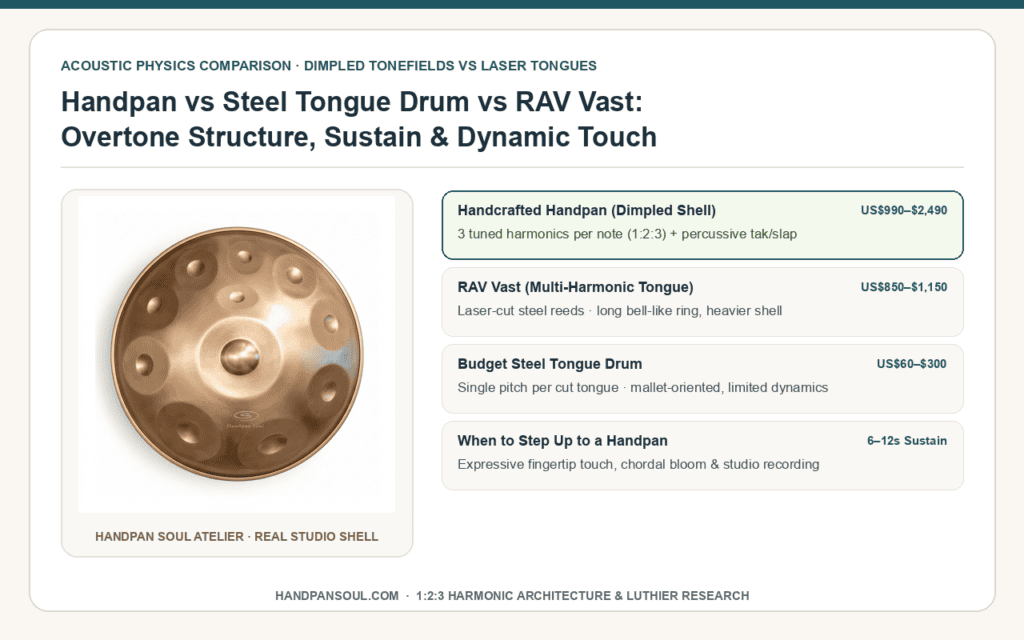
A steel tongue drum (US$60–US$350) cuts three-sided U-shaped slots into thick steel with a CNC laser; each metal flap vibrates as a fixed-free cantilever beam with naturally inharmonic upper modes unless specially undercut, and is normally played with rubber mallets. A handpan (Standard Atelier US$990–US$3,990) contains zero cuts: a luthier hammers localized elliptical membranes within a continuous stressed shell so every single note sings three harmonically locked partials (1 : 2 : 3 — Fundamental, Octave, and Twelfth) coupled to a central Helmholtz air chamber under bare-finger touch.
First-time buyers browsing major marketplaces routinely encounter saucer-shaped metal drums advertised as “15-Note Handpan Tongue Drum — $149”. From across a room, both instruments are circular steel vessels arranged around a center note. On an acoustic bench, however, they obey completely different boundary equations—as mechanically distinct as a plucked thumb kalimba and an acoustic grand piano.
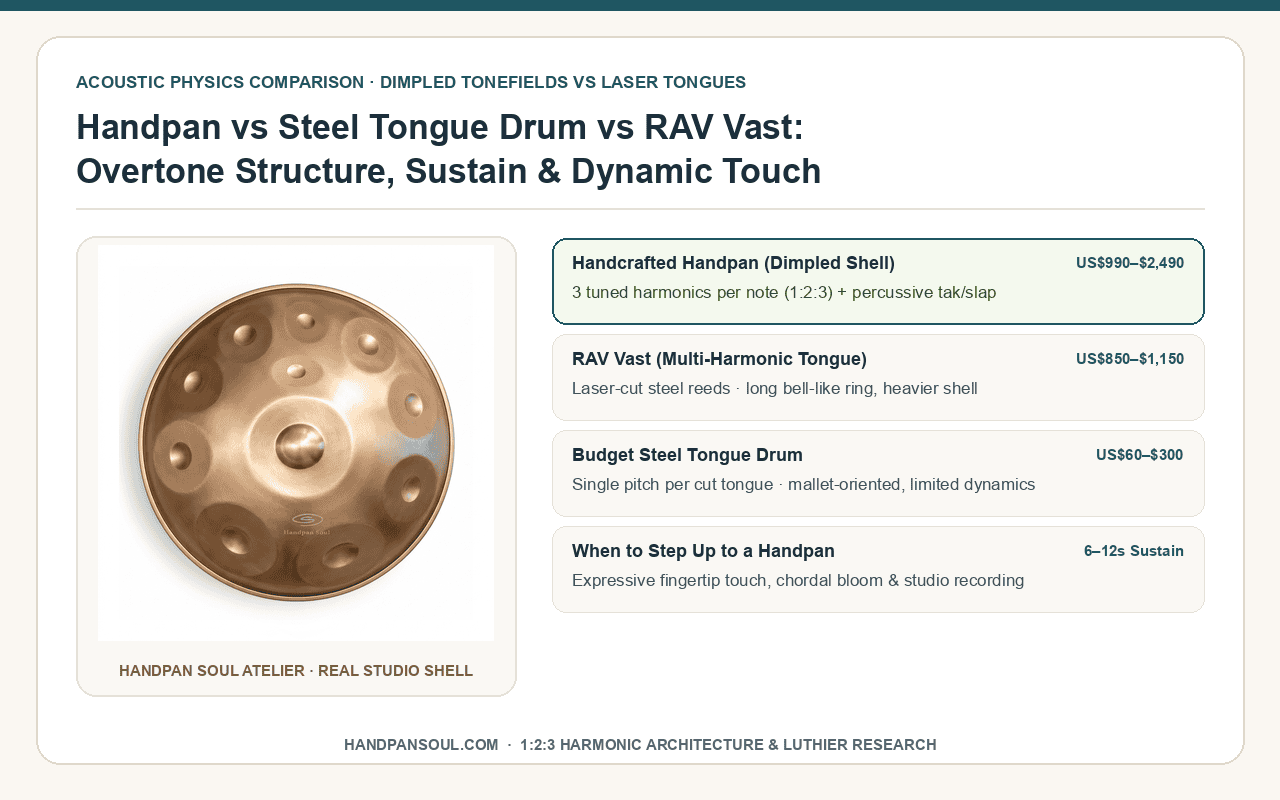
1. Boundary Mechanics: Fixed-Free Cantilever Beam vs. Localized Elliptical Shell
How a Steel Tongue Drum Vibrates (Slotted Idiophone)
A standard tongue drum begins with a thick pressed steel tank (typically 2.0–3.0 mm gauge). A laser or plasma cutter slices curved U- or C-shaped slots through the top surface, leaving a metal tab clamped at its base and free at its tip. Under Euler–Bernoulli beam theory, a uniform clamped-free bar produces transverse bending overtones near 1 : 6.27 : 17.55—far outside musical octaves. While expensive multi-tongue hybrid drums shape or step the slot geometry to tame upper partials, entry tongue drums tune primarily the fundamental pitch, creating a pure, music-box chime that responds best to rubber mallets.
How a Handpan Vibrates (3-Mode Localized Shell + Helmholtz Cavity)
A handpan uses a continuous 1.0–1.15 mm nitrided or stainless hemisphere with zero slots. As demonstrated in curved-shell localization research (Bryde & Mahadevan, 2023), curvature and hammered shoulder boundaries trap vibrational energy inside each elliptical field while an inverted central dimple stiffens the center. Across 3,000 to 6,000 manual hammer strikes and multiple kiln heat cycles, the luthier aligns three lowest modes inside every single oval:
- Mode (0,0) — Fundamental (
1f): Symmetric breathing motion of the entire tonefield (e.g.,A3 = 220.00 Hz). - Mode (1,0) — Octave Partial (
2f): Nodal line across the short axis, bending along the long axis atA4 = 440.00 Hz. - Mode (0,1) — Compound Fifth / Twelfth (
3f): Nodal line along the long axis, bending across the short axis nearE5 = 660.00 Hz.
At the same time, the enclosed air volume between the bonded upper and lower shells acts as a Helmholtz resonator through the bottom Gu neck (~78–87 Hz), adding chest-filling sub-bass warmth that slotted tank bodies cannot seal or project in the same way.
Roughly once a month, a player messages our workshop asking if we can hammer a US$180 tongue drum to give it handpan sustain. On a spectrum analyzer, a clean handpan A3 field locks f, 2f, and 3f across 1:2:3 partials so all three partials reinforce each other acoustically as the note blooms. On a laser-cut tongue, pitch is governed by slot length and base thickness: grinding the base lowers pitch, and adding solder or magnets to the tip lowers pitch, whereas hammering the tongue face warps tip clearance and introduces metallic buzz.
We also test cavity coupling unobstructed. Setting a tongue drum flat on a wooden table blocks its bottom port and chokes specific notes whose fundamental sits near the box resonance. Always audition both instruments at equal finger force with the underside port open before judging volume or decay.
2. Engineering & Buyer Diagnostic Matrix
| Diagnostic Criterion | Standard Steel Tongue Drum | Multi-Harmonic Hybrid (RAV-Style) | Hand-Hammered Luthier Handpan |
|---|---|---|---|
| Vibrating Element | CNC laser-cut cantilever flap in 2–3 mm tank | Double-tiered laser-cut steel tongues | Continuous 1.0–1.15 mm stressed shell membrane |
| Spectral Target | 1 tuned fundamental (inharmonic upper beam modes) | 2–3 partials along elongated tongues | Strict 1 : 2 : 3 (f, 2f, 3f across 1:2:3 partials) |
| Primary Excitation | Soft rubber mallets (stiff under bare fingers) | Thumbs / fingertips; long ambient wash | Bare finger pads, thumb rolls, ghost notes & palm mutes |
| Percussive Vocabulary | Narrow (non-tongue shell clangs under fingers) | Moderate center & rim clicks | Wide (interstitial shoulder “Tak”, Ding pulse, Gu pitch bend) |
| Service & Retuning | Adjusted via slot depth, tip filing, or magnets | Factory specialist reed adjustment | Skilled luthier hammer voicing across coupled shell |
| Honest Price Anchor | US$60 – US$350 | US$750 – US$1,100 | US$990 – US$3,990 (Handpan Soul Atelier) |
3. Listen to True 1:2:3 Handpan Harmonics (Bare Fingertips, Zero Mallets)
Listen with headphones to the opening bloom and natural fade of each note in our unedited studio recording below. Notice how every light finger tap blends a warm low fundamental with an airy flute-like twelfth shimmer—while crisp interstitial finger taps keep rhythmic pulse between melodic phrases:
4. How to Spot a Tongue Drum Disguised as a “Budget Handpan” Online
Dropshippers routinely photograph tongue drums from directly overhead in dim lighting—or pair stolen videos of US$2,000 stainless handpans with US$199 slotted drums. Check three details in under ten seconds:
- Three-Sided Cutouts & Sticker Numbers: Visible U-shaped slits or numbered paper stickers bundled with two rubber mallets confirm a tongue drum—fair value is US$80–US$250, never US$600+.
- Closed Elliptical Borders & Dimples: Genuine handpans feature continuous metal with raised or recessed central dimples surrounded by smooth oval shoulders.
- Pre-dispatch workshop tuning check: Reputable makers play and check every tonefield across fundamental, octave, and fifth partials before packing; commodity warehouses ship sealed cartons untested. Read our 7-Point Handpan Price & Scam Audit before buying on open marketplaces.
5. When Should You Choose a Tongue Drum vs. a Handpan?
A US$120 steel tongue drum is a practical, weather-tolerant choice for young children under age 8 who enjoy tapping with mallets, campfires, or garden soundscapes. However, if your goal is bare-hand fingerstyle dynamics, yoga/sound-bath facilitation, or learning handpan repertoire, starting on a tongue drum rarely transfers muscle memory because mallet rebound differs completely from 20 ms bare-finger handpan technique. Beginning directly on a Moon 9-Note Nitrided (US$990) or our flagship 14-Note D Kurd (12+2) gives you true 1:2:3 harmonic response from Day 1.
Room Acoustics & Microphone Recording Comparison
For content creators, therapists, and home-studio musicians recording into a condenser microphone or smartphone interface, the radiation pattern of the two instruments also behaves very differently. A slotted tongue drum projects a narrow transient spike at the instant the rubber mallet strikes the steel flap, followed by a fast drop in mid-bass body—often requiring heavy digital EQ and artificial hall reverb to sit warmly in a mix. A handpan radiates low frequencies omnidirectionally from its underside Gu port while projecting directional 2f and 3f harmonics upward from the top tonefields, filling a yoga studio or living room naturally without amplification or digital plugins.
6. Frequently Asked Questions
Why does a handpan sustain and bloom differently than a steel tongue drum?
A handpan tonefield vibrates as a curved, compressively stressed membrane whose first three modes are tuned to a harmonic 1:2:3 ratio (fundamental, octave, twelfth) reinforced by a Helmholtz air cavity. Standard laser-cut tongues vibrate as clamped-free cantilever beams whose upper modes sit at inharmonic ratios (~1 : 6.27), creating a short bell ping rather than a blooming chordal voice.
Which is easier to play first, a handpan or a tongue drum?
A tongue drum produces an immediate chime with soft rubber mallets on day one, making it simple for children. A handpan asks for relaxed bare-finger rebound, yet because all notes on a D Kurd or E Amara handpan share one harmonious scale, complete beginners play flowing melodies within 15 minutes.
Can YouTube handpan tutorials be played on a tongue drum?
Slow numbered melodies can be adapted if both instruments share a D minor layout, but core handpan techniques—split-hand thumb/index rolls, shoulder “Tak” backbeats, Gu bass pulses, and harmonic isolation on the 2f or 3f edge—cannot be executed on slotted metal tongues.
Which instrument is quieter for late-night apartment practice?
Played gently with bare finger pads on a tripod stand over a rug, a handpan whispers at 52–58 dB while keeping full harmonic warmth, whereas mallet strikes on a tongue drum create a sharper transient click through walls.
Primary Acoustic & Engineering References
- Morrison, A., & Rossing, T. D. (2007). “Modes of Vibration and Sound Radiation from the Hang.” Archives of Acoustics, 32(3), 551–560. acoustics.ippt.pan.pl
- Bocanegra Cifuentes, J. A., & Borelli, D. (2021). “Experimental Characterization of the Steel Tongue Drum.” Proceedings of the 27th International Congress on Sound and Vibration (ICSV27), International Institute of Acoustics and Vibration. University of Genoa Repository
- Bryde, P., & Mahadevan, L. (2023). “Localization in Musical Steelpans.” Proceedings of the Royal Society A, 479, 20220869. doi:10.1098/rspa.2022.0869
- Rossing, T. D. (2000). Science of Percussion Instruments. Singapore: World Scientific Publishing.
Test Authentic 1:2:3 Handpan Harmonics in Your Browser
Tap individual tonefields on our interactive 14-Note & 19-Note studio simulators to hear real Stainless & Nitrided samples before deciding.
Play the Interactive 14-Note Simulator →