
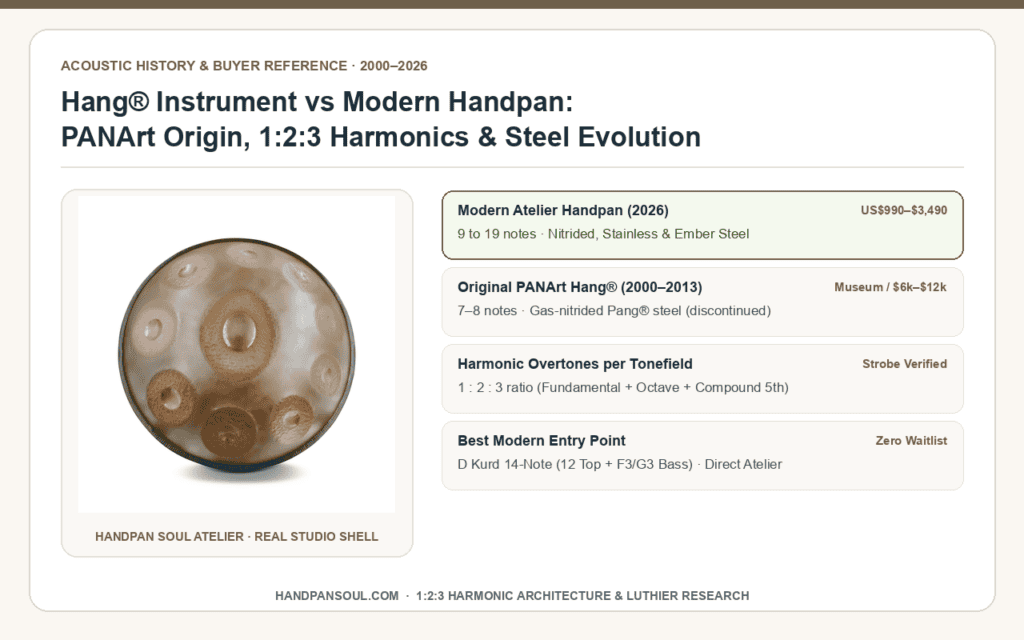
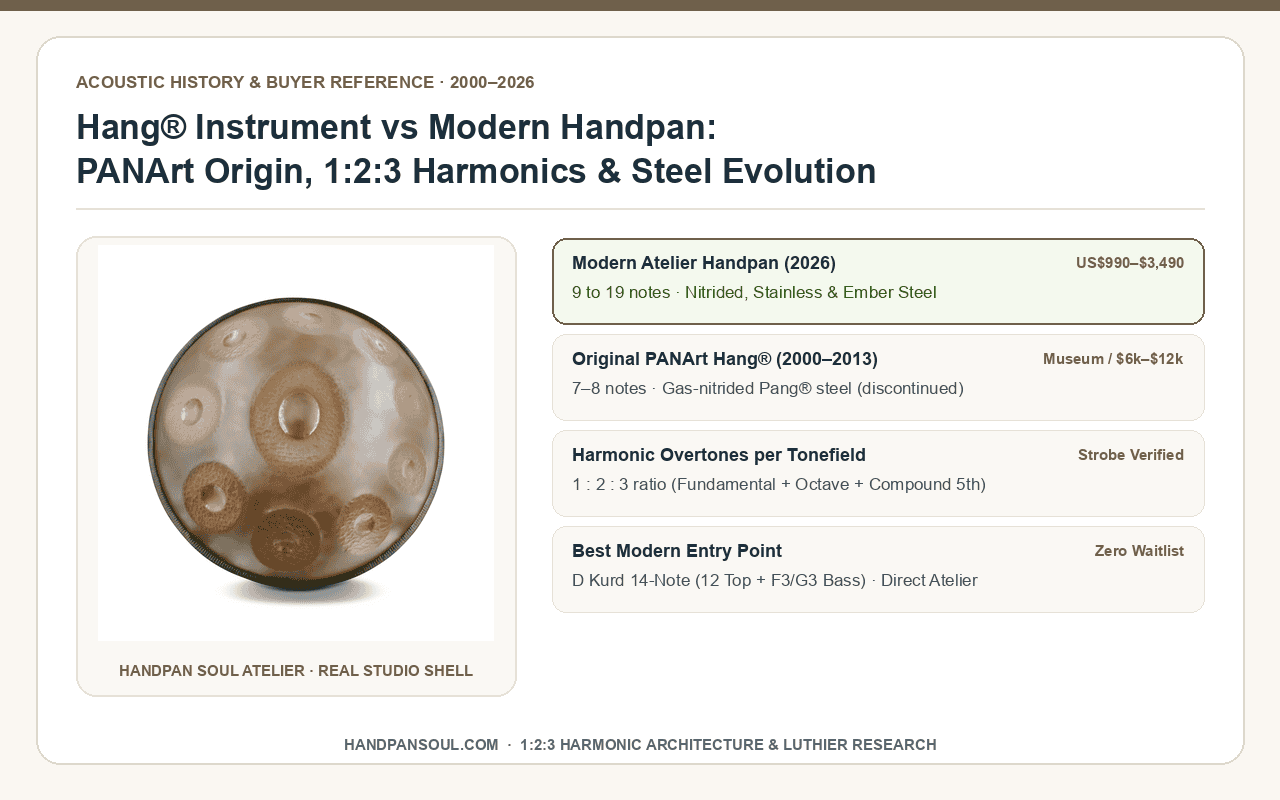
Hang® is a registered trademark of PANArt Hangbau AG in Bern, Switzerland, denoting the specific gas-nitrided steel sound sculptures built by Felix Rohner and Sabina Schärer between 2000 and late 2013. Handpan is the universal musical category coined in 2007 for hand-played convex steel instruments built by independent luthiers worldwide. Original Bern Hang sculptures are no longer sold new and trade strictly on secondary collector markets, whereas modern atelier handpans expand the harmonic vocabulary from 7–8 notes up to 14-note (12+2) and 19-note (12+7) dual-shell architectures across Warm Nitrided, Crafted Stainless, and Collector Ember Steel (Standard Atelier US$990–US$3,990).
Search engines still log more than 33,000 monthly queries for “hang drum” and “hang instrument”—most from listeners who heard a warm, resonant steel melody in a film score, yoga sanctuary, or street performance and want to learn it themselves. Two facts clarify the search immediately: first, Rohner and Schärer discouraged calling their creation a “drum” because striking thin tensioned steel like a conga knocks tonefields out of alignment; second, PANArt voluntarily ended sales of the classic Hang in December 2013 to concentrate on its Gubal® and Pang® ensemble instruments.
This guide separates primary historical documentation from forum myth, explains how luthiers measure f : 2f : 3f harmonic partials on our tuning bench, and maps which modern steel alloy and scale layout matches the exact timbre in your ear.
1. Why “Hang” Means “Hand” — and Why “Handpan” Emerged in 2007
During the late 1990s, Swiss steelpan tuners Felix Rohner and Sabina Schärer studied Caribbean 55-gallon steelpan acoustics alongside a South Indian clay pot percussion instrument called the Ghatam. By clamping two deep-drawn, gas-nitrided carbon-steel hemispheres together—placing a central convex dome (the Ding) surrounded by elliptical tonefields on the upper shell and a Helmholtz bass port (the Gu) underneath—they introduced the first Hang® at the Frankfurt Musikmesse in 2001. In Bernese German, Hang translates directly to hand.
Global demand quickly outstripped what two sound sculptors in Bern could hammer by hand. In autumn 2007, when American steelpan builder Kyle Cox (Pantheon Steel) introduced the Halo and players gathered on early community forums, musicians adopted the neutral generic noun handpan. Using handpan respects PANArt’s trademark while accurately naming the broader acoustic family of hand-played harmonic steel shells.
When our bench evaluates any vintage shell or newly formed handpan, we rest the rim on an open stand that never blocks the underside GU port, reference A4 = 440.00 Hz on a chromatic tuner, and check three light finger strikes per tonefield. A true handpan note locks three orthogonal membrane modes into a 1 : 2 : 3 numeric frequency ratio: the fundamental (f), longitudinal octave (2f), and transverse compound fifth or twelfth (3f).
Here is a subtle acoustic distinction that separates trained luthiers from smartphone tuner apps: on a D3 Ding whose fundamental sits at 146.83 Hz, the natural 2f octave targets 293.66 Hz, while the pure harmonic 3f twelfth targets 440.50 Hz—nearly +1.96 cents higher than equal-tempered A4 = 440.00 Hz! Meanwhile, a phone app locks onto whichever partial is loudest, hiding whether the fundamental sits at −14 cents while the twelfth sits at +9 cents (the exact spread the human ear perceives as a muddy, beating warble). Holding all three modes within concert tolerance of their true harmonic targets eliminates warble before an instrument ever ships.
2. Side-by-Side Acoustic Specification: Historical Hang® (2000–2013) vs. Modern Handpan
| Acoustic Parameter | Historical Swiss Hang® (2000–2013) | Modern Luthier Handpan (Handpan Soul Atelier) |
|---|---|---|
| Trademark & Maker | Registered trademark of PANArt Hangbau AG (Bern, Switzerland) | Open acoustic instrument category crafted by independent ateliers worldwide |
| Typical Note Count | 1st Gen: Ding + 7 or 8 notes · Integral (2008): Ding + 7 notes (D3 + A3 Bb3 C4 D4 E4 F4 A4) |
9 to 12 single-shell notes, 14-Note (12 Top + 2 Bass), up to 19-Note Dual-Shell Concert |
| Shell Metallurgy | Gas-nitrided DC04 carbon steel (Pang® composite sheet; brass-coated rims from 2006) | 3 distinct tiers: Warm Nitrided (crisp woody pulse), Crafted Stainless ★ (lingering chapel sustain), Collector Ember (velvety bronze fade) |
| Harmonic Sustain | Short, dry, ceramic-woody sustain (like an intimate wooden guitar body) with crisp percussive shoulder articulation | Tailored by alloy: crisp acoustic-wood pulse (Nitrided) to lingering chapel & bronze-cello bloom (Stainless & Ember) |
| Reference Pitch | 1st/2nd Gen: 440 Hz · Integral (2008) & Free Integral (2010): free-tuned by ear without digital tuners | Hand-tuned A4 = 440 Hz Concert Pitch or dedicated 432 Hz Sanctuary Tuning |
| Availability & Price | Ended Dec 2013; secondary collector market only (high unverified-tuning & fraud risk) | Built fresh in our workshop: Standard Atelier US$990–US$3,990 (US$0 Express Air) |
3. Four Generations of the Historical Hang — Explained for Musicians
- First Generation (2001–2005): Built in up to 45 world-music scales (Aeolian, Hijaz, Pygmy, Akebono) with 7 or 8 radially aligned tonefields around the Ding and brighter high overtones.
- Low Hang / Second Generation (2006–2007): Added a brass-coated rim, deeper
D3voice, and 45-degree rotated elliptical axes that stabilized longitudinal octave and transverse fifth modes. - Integral Hang (2008–2009): Standardized onto one 8-note chorale layout (
D3Ding +A3, Bb3, C4, D4, E4, F4, A4). Notice thatG4was intentionally omitted compared to modern 9-note D Kurd, creating an open minor-third leap betweenF4andA4. - Free Integral Hang (2010–2013): Tuned purely by ear and bodily feel without electronic tuner references, sitting slightly below 440 Hz, prior to PANArt’s December 2013 transition to the Gubal®.
4. Hear the Timbre Difference: Dry Nitrided Heritage vs. Blooming Stainless Sustain
When listeners recall 2005–2012 street or acoustic ensemble recordings, the voice in their memory is Gas-Nitrided DC04 Carbon Steel: earthy, ceramic, and percussive, stepping aside with focused woody clarity so rapid 16th-note finger rolls stay crisp without blurring.
When listeners recall modern post-2018 solo forest or sound-bath performances, the voice they hear is almost always Crafted Stainless Steel or Collector Ember Steel: lush, lingering sustain (like a sunlit stone chapel or warm cello wood) where three sequential notes hang together in the room as a shimmering triad.
5. Exact Pitch Comparison: 2008 Integral Hang vs. Modern D Kurd 9 & 14-Note
Many students wonder why modern YouTube D Kurd songs cannot be played note-for-note on an 8-note Integral layout. Compare the exact concert frequencies (A4 = 440 Hz) across layouts:
| Scale Register | 2008 Integral Hang (7+1) | Modern D Kurd 9 (8+1) | 14-Note D Kurd (12 Top + 2 Bottom) |
|---|---|---|---|
| Root Center Ding | D3 (146.83 Hz) | D3 (146.83 Hz) | D3 (146.83 Hz) |
| Sub-Chordal Bass (3rd & 4th) | Absent | Absent | F3 (174.61 Hz) & G3 (196.00 Hz) Underside |
| Lower Chorale Ring | A3 · Bb3 · C4 · D4 | A3 · Bb3 · C4 · D4 | A3 · Bb3 · C4 · D4 |
| Middle Melodic Ring | E4 · F4 · (No G4) · A4 | E4 · F4 · G4 (392.00 Hz) · A4 | E4 · F4 · G4 (392.00 Hz) · A4 |
| Upper Crown Sing-Out | Absent | C5 (523.25 Hz) | C5 · D5 (587.33 Hz) · E5 (659.25 Hz) |
6. Buyer Decision Matrix: Historical Collector Piece vs. Modern Atelier Handpan
| Player Objective | Recommended Candidate | Standard Atelier Anchor | Mandatory Pre-Purchase Verification |
|---|---|---|---|
| Museum / Historical Collector | Authenticated 2001–2013 PANArt Hang® | Secondary auction dependent | Original Bern paperwork, rim/underside corrosion check, tuner check across all 3 partials (PANArt does not retune legacy shells) |
| Compact Portable Starter | 9-Note Nitrided or Crafted Stainless | US$990 (Nitrided) · US$1,190 (Stainless) | Confirm A4 = 440 Hz reference, pre-dispatch tuning check, and padded bag inclusion |
| Buy-Once Beginner-to-Pro Sweet Spot | 14-Note D Kurd (12+2) | US$1,490 Nitrided · US$1,690 Stainless ★ · US$2,690 Ember | Verify clean cross-talk isolation between D3 Ding and D4/D5 octaves plus F3/G3 underside ergonomics (check live page for seasonal privileges) |
| Sound-Bath & Coastal Studio Work | Aegean 11-Note 432 Hz or Stainless 14n | US$1,590 Stainless · US$2,590 Ember | Match 432 Hz vs. 440 Hz reference to existing crystal bowls or studio instruments |
| 2.5-Octave Concert Composition | D Kurd Master 16 & 19-Note Dual-Shell | 16n: US$2,090 / US$3,090 · 19n: US$2,990 / US$3,990 | Test seated tripod clearance for 4 to 7 bottom notes and pair with a 56 cm Flight Case (US$200) |
7. Frequently Asked Questions
Is a Hang drum the same as a handpan?
Hang® is the registered trademark of PANArt Hangbau AG for the specific gas-nitrided sound sculptures built in Bern from 2000 to late 2013. Handpan is the broader musical category for hand-played convex steel instruments crafted by independent luthiers worldwide across Nitrided, Stainless, and Ember Steel.
Why shouldn’t I play a handpan with drumsticks or mallets?
Every handpan tonefield is a thin (1.0–1.15 mm) compressively stressed steel membrane balanced across three compound modes (f, 2f, 3f). Hard rubber or wooden mallets concentrate impact energy onto a narrow point, stretching the dimple boundary and detuning the octave and twelfth. Always strike lightly with relaxed bare finger pads.
How much does a new luthier handpan cost compared with a vintage Hang today?
Because PANArt ended Hang sales in December 2013, authentic Bern instruments appear only on secondary collector markets (often US$5,500–US$12,000+ without maker warranty). A brand-new hand-tuned handpan from Handpan Soul starts at US$990 (9-note Nitrided) and US$1,490–US$1,690 for a 14-note D Kurd 12+2 in Nitrided or Crafted Stainless Steel, including $0 Express Air shipping.
Is Handpan Soul affiliated with PANArt Hangbau AG?
No. Handpan Soul is an independent handpan atelier established in 2018. Hang® and Pang® are registered trademarks of PANArt Hangbau AG (Bern, Switzerland), referenced in this article strictly for historical and acoustic comparison.
Primary Acoustic & Historical References
- Rohner, F., & Schärer, S. (2007). “History, Development and Tuning of the HANG.” Proceedings of the International Symposium on Musical Acoustics (ISMA 2007), Barcelona.
- Morrison, A., & Rossing, T. D. (2007). “Modes of Vibration and Sound Radiation from the Hang.” Archives of Acoustics, 32(3), 551–560. acoustics.ippt.pan.pl
- Morrison, A., & Rossing, T. D. (2009). “The extraordinary sound of the Hang.” Physics Today, 62(3), 66–67. physicstoday.aip.org
- PANArt Hangbau AG (2014). “From the Hang to the Gubal.” Official Bern historical chronology. panart.ch
Compare Nitrided, Stainless & Ember Steel With Unedited Studio Audio
Tap individual notes on our interactive 14-Note & 19-Note simulators or use our 30-Second Matcher to choose your ideal steel alloy.
Try the 30-Second Handpan Matcher →