
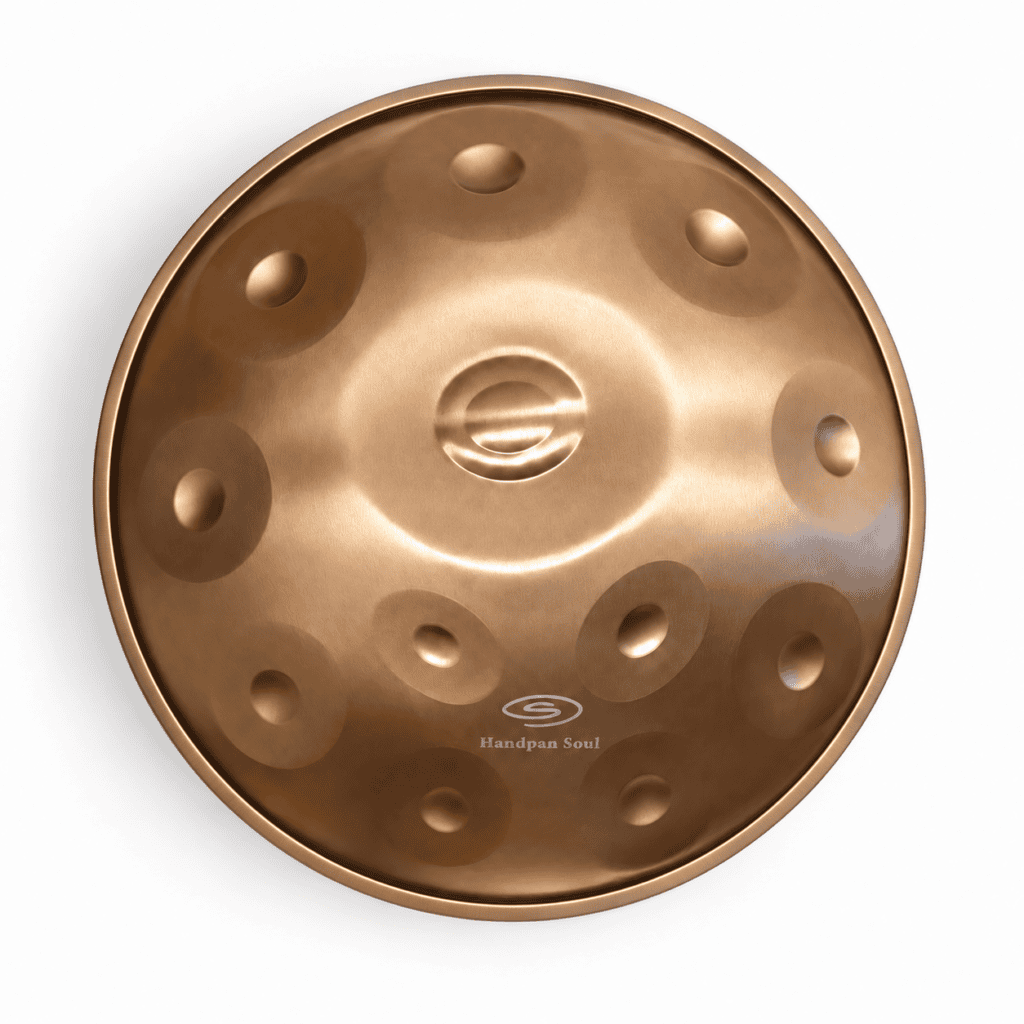
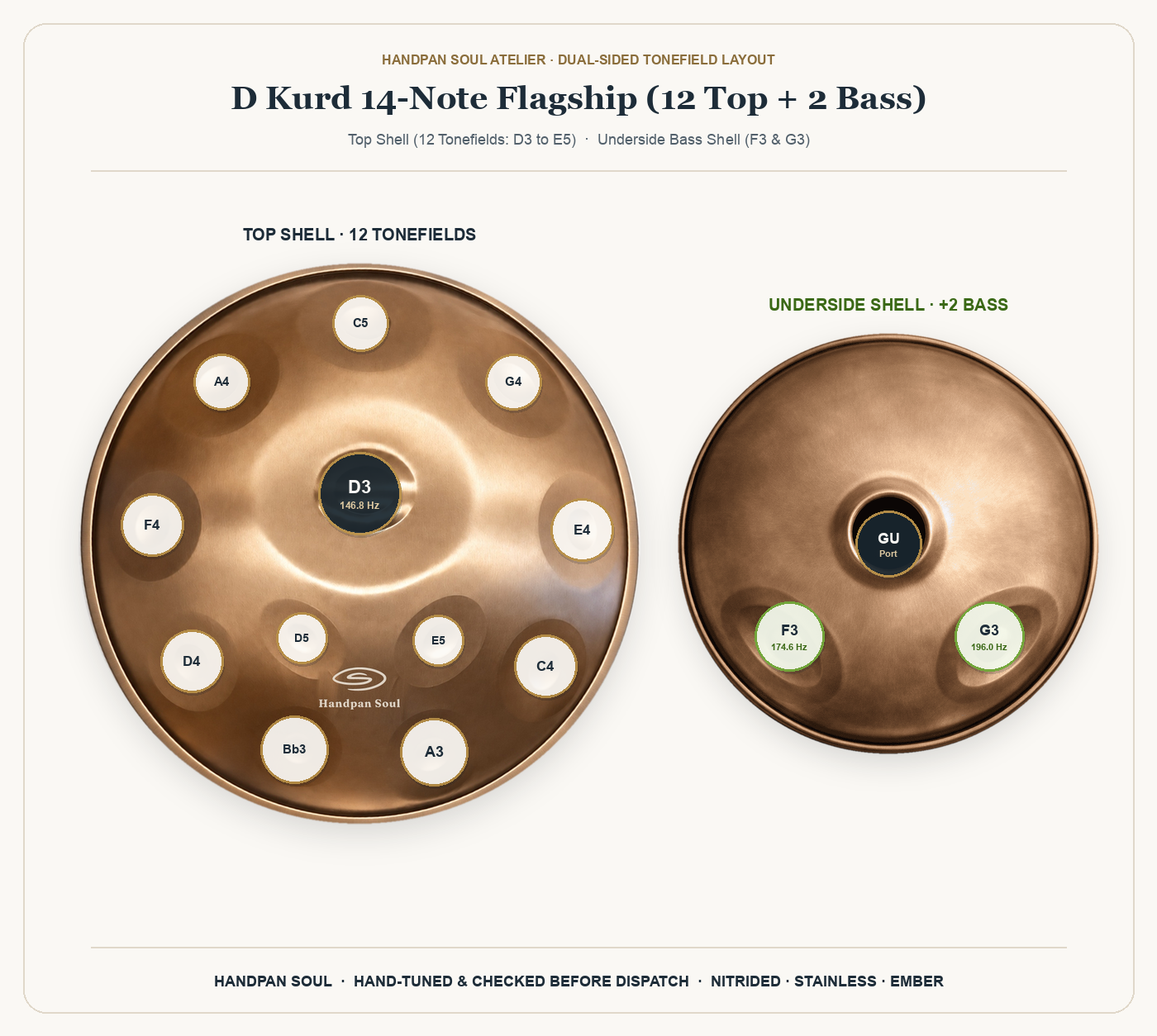
For 90% of first-time players, a D Kurd 14-Note (12 Top + 2 Underside Bass) in Crafted Stainless Steel (Standard Atelier US$1,690; Nitrided US$1,490) is the safest buy-once starting instrument: every note is harmonically locked so dissonant clashes are physically impossible, over 80% of online lessons teach on D Kurd in A4 = 440 Hz, and the 12-note top shell preserves generous finger spacing while placing F3 and G3 bass domes underneath so you never outgrow a 9-note shell in Month 2.
Choosing your first handpan feels intimidating only until you separate marketing noise from three physical decisions: scale compatibility, note count ergonomics, and steel sustain. Unlike fretted strings or reed instruments that require months of embouchure or callus training before a single scale sounds clean, a hand-tuned handpan builds consonant harmony directly into curved steel geometry.
1. Why Complete Beginners Never Hit a Dissonant “Wrong Note”
A piano lays all twelve chromatic semitones side by side—striking D, Eb, and E together produces immediate tension unless you know music theory. A diatonic minor handpan such as D Kurd selects only the seven natural Aeolian degrees (D – E – F – G – A – Bb – C). Whether you alternate thumbs up the ring or tap adjacent tonefields with your eyes closed, every dyad forms a consonant third, fourth, fifth, or sixth. To see how numbered patterns work in your first 15 minutes, read our Beginner Touch & 4 Numbered Song Tabs Guide.
2. 9-Note vs. 12-Note vs. 14-Note (12+2): Avoiding the 60-Day Upgrade Wall
Conventional 9-note starter pans stop at A3 as their lowest ring note above the D3 Ding. That works nicely for simple pentatonic loops during your first three weeks. By Month 2, however, nearly every student wants to play cinematic progressions such as Interstellar or warm Bb – F – G – Dm songwriting cadences—which depend on F3 (174.61 Hz) and G3 (196.00 Hz) bass roots.
Cramming 14 tonefields onto the top hemisphere alone shrinks every note border and crowds beginner hands. Placing 12 notes on top and 2 bass domes underneath solves both problems simultaneously: your top shell feels just as open as a 12-note model while unlocking full bass harmony whenever you are ready.
| Architecture | Standard Atelier Anchor | Lowest Chord Roots | Top-Shell Spacing | 3-Year Ownership Verdict |
|---|---|---|---|---|
| 9–10 Note Single-Shell (Moon 9 / Ocean Blue 9) | US$990 Nitrided · US$1,190 Stainless | D3 Ding + A3 ring | Extra wide | Ideal for ultralight travel, hiking & compact budgets |
| 12-Note Single-Shell (Moon 12) | US$1,290 Nitrided · US$1,490 Stainless | D3 + A3 (adds C5, D5, E5 highs) | Spacious | Extended upper melody, though lacks F3 & G3 bass |
| 14-Note Dual-Shell (12+2) ★ (14-Note D Kurd) | US$1,490 Nitrided · US$1,690 Stainless ★ (check live page for seasonal privileges) | D3 + F3 & G3 Underside Bass | Identical 12-top spacing | #1 Buy-Once Sweet Spot — zero need to trade up later |
| 16 & 19-Note Concert Master (D Kurd Master) | US$2,090 / US$2,990 Stainless | D3 + E3, F3, G3 + upper mutants | 12-top concert layout | Built for pianists, composers & studio performers |
During a player’s first two weeks, finger-pad release speed is still developing. On focused-decay carbon-nitrided shells (like plucking dry acoustic wood), a slightly hesitant tap sounds brief until fingertip rebound sharpens. On Crafted Stainless Steel (bright, lingering chapel-like sustain), even a whisper-light fingertip tap blooms effortlessly into its 1 : 2 : 3 fundamental, octave, and twelfth partials—giving beginners instant acoustic reward at low apartment volume while providing natural chromium-oxide protection against sweaty palms and coastal humidity.
3. Four Non-Negotiable Checks Before Ordering Your First Handpan
- Confirm
A4 = 440 HzConcert Pitch: Standard 440 Hz ensures your pan matches every online D Kurd tutorial, backing track, piano, and acoustic guitar. Reserve 432 Hz Sanctuary Tuning strictly for solo sound-bath work or 432 Hz crystal bowl sets. - Avoid US$200–US$450 Marketplace Traps: Low-priced stamped drums are either slotted steel tongue drums or un-annealed sheet metal with 30+ cent harmonic drift. Review our Handpan Price & Scam Audit before buying anywhere.
- Check 1:2:3 Harmonic Balance: Every Handpan Soul handpan is tuned by hand across fundamental, octave, and fifth partials, and checked note-by-note before dispatch.
- Check Complete Starter Hardware & DDP Delivery: Dual-shell 14-note pans play best on a wooden stand. Every Handpan Soul instrument ships with a foldable solid-wood tripod stand, padded backpack, microfiber cloth, 7-Day Beginner Course, and US$0 Free Insured Express Air Shipping (with DDP customs duties covered for USA and European buyers).
4. Listen Unedited — 14-Note Crafted Stainless D Kurd (440 Hz)
5. Frequently Asked Questions
Do I need to read sheet music or have rhythm experience to start?
No. Over 70% of Handpan Soul owners start with zero prior musical training. Because all notes on a D Kurd handpan belong to one consonant minor scale and lessons use simple numbers (D, 1–11), beginners play calming patterns within 15 minutes.
Is a 14-note (12+2) handpan harder to learn than a 9-note?
No. You play only the spacious top notes during your first few weeks, exactly like a standard single-sided handpan, and bring in the two underside bass notes (F3 and G3) whenever you are ready to play full chord progressions.
Should a beginner choose Nitrided Steel or Crafted Stainless Steel?
Choose Crafted Stainless Steel (+US$200 over Nitrided) if you love bright, lingering melodic sustain (like playing in a sunlit stone chapel), gentle fingertip response, and low-maintenance rust resistance. Choose Warm Nitrided Steel if you prefer fast, earthy percussive fingerstyle grooves with crisp acoustic-wood separation.
Is a handpan too loud for apartment living?
Played properly with bare finger pads on a tripod stand over a rug, a handpan averages 55–68 dB—comparable to a calm conversation and far quieter than an acoustic guitar, piano, or drum kit.
Primary Acoustic & Pedagogical References
- Morrison, A., & Rossing, T. D. (2007). “Modes of Vibration and Sound Radiation from the Hang.” Archives of Acoustics, 32(3), 551–560. acoustics.ippt.pan.pl
- Dahl, S. (2011). “Striking Movements: A Survey of Motion Analysis of Percussionists.” Acoustical Science and Technology, 32(5), 168–173. doi:10.1250/ast.32.168
- Bryde, P., & Mahadevan, L. (2023). “Localization in Musical Steelpans.” Proceedings of the Royal Society A, 479, 20220869. doi:10.1098/rspa.2022.0869
Test All 14 Notes in Your Browser Before Ordering
Tap individual top and underside bass notes on our 48 kHz studio simulator—or take our 30-second matcher quiz.
Play the 14-Note D Kurd Simulator →