
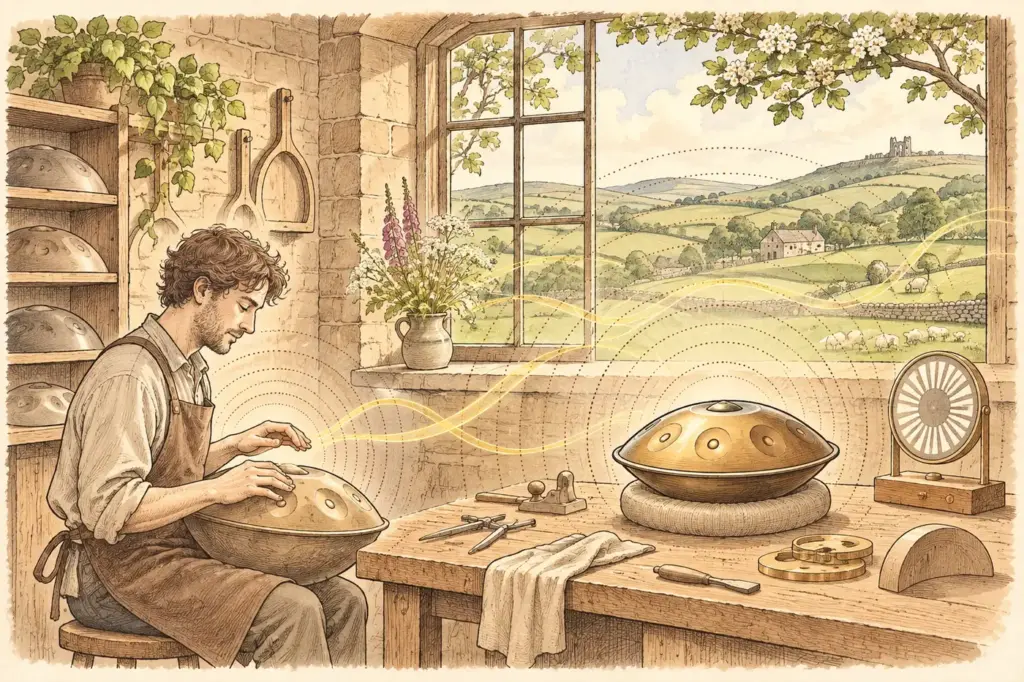
You can check a handpan’s tuning yourself, but you should not try to retune it with a hammer at home. Each tone field holds a fundamental, an octave and a compound fifth in a 1:2:3 ratio, all set by tension spread across the shell, so a single wrong blow can detune neighbouring notes or damage the steel for good.

What tuning a handpan actually involves
A handpan note is not a single pitch. Each tone field is a shaped area of steel that vibrates in several modes at once. A well-tuned field gives three main partials: the fundamental, the octave at twice that frequency, and the compound fifth (an octave plus a fifth) at three times that frequency. On the D3 Ding of a D Kurd, that comes to roughly 146.8 Hz, 293.7 Hz and 440.5 Hz. The 1:2:3 ratio is what makes the note sound clean and sustained instead of metallic or clangy.
Each of those partials depends on how tension is spread through the field and around its border. A tuner changes that tension with controlled hammer blows, some inside the field, some on its edge, and some in the steel between notes. Each correction is checked against a strobe or spectrum reading before the next blow. A large field like the Ding may need dozens of light, precisely placed strikes, and the tuner goes back over the whole instrument several times because changing one note shifts its neighbours.
In our workshop we record every note at 48 kHz and check all three partials on each field before an instrument ships. On the 14-Note D Kurd Crafted Stainless that means 14 fields: the Ding, 11 tone fields on top and the F3 and G3 bass notes on the underside. That is 42 partials to line up, and every one of them responds to tension shared across the same shell.
Why DIY hammering fails
Online videos make tuning look like tapping a note until the app turns green. Here is why that approach goes wrong.
- You only see the fundamental. Most phone tuner apps lock onto the loudest partial. You can bring the fundamental into tune while pushing the octave 20 cents away from it. The note will then pass the app’s check and still sound wrong when you play it.
- Tension moves across the shell. Hammering the E4 field changes the stress in the steel shared with D4 and F4. Fix one note and its neighbours drift. Professional tuners plan each blow around this. Beginners end up chasing drift across the whole instrument.
- Steel remembers. Each blow work-hardens the metal a little. Overcorrecting and then hammering back the other way leaves a field stiffer and less stable than before. Sustain gets shorter and the field can start to buzz or fold.
- Surface treatments break. Nitrided shells have a hard surface layer that protects them from corrosion. Heavy or badly placed blows can crack that layer, and a field that has been over-stretched cannot always be brought back.
- Direction matters. Some corrections are made from inside the shell, around the edge of a field, or on the underside. Without the right support tools and a clear plan, a home attempt usually makes the note worse.
Most of the damaged instruments we see were not ruined by a drop. They were ruined by an owner trying to fix a small issue with a mallet and a phone app.
How to check your tuning before deciding anything
Checking costs nothing and is safe. Our free in-browser handpan tuner in the Handpan Soul Studio reads the note you play and shows how far it sits from target in cents (1 cent is one hundredth of a semitone). Work through these steps:
- Let the instrument settle. Keep it indoors at normal room temperature for at least an hour. Steel straight from a cold car or hot sun reads several cents off and recovers as it warms or cools.
- Use a quiet room. Turn off fans and air conditioning. Hold your phone or laptop microphone about 30 cm above the note.
- Strike with a bare finger and let it bounce off. Play at medium strength, close to the centre of the field. Letting the finger rebound gives a clean fundamental without the extra noise a mallet or fingernail adds.
- Record the fundamental. Write down the cents reading for each note in turn. On a 14-note instrument, include both bottom notes.
- Listen for the octave and fifth. Play the note softly near the edge of the field to bring out the higher partials, then compare readings. A warble or beating sound that grows as the note rings out means the partials have moved apart.
- Repeat the next day. One odd reading may come from temperature or your stroke. Two matching sessions tell you what is really going on.
Owners who use the Studio tuner tab to keep a monthly tuning log spot drift long before it becomes audible in a song, and a log makes any conversation with a tuner far more precise.
When professional retuning is needed
Small variations are normal. A shell responds to temperature, playing force and age. Use this table to judge what you are hearing:
| What you notice | Typical reading | Recommended action |
|---|---|---|
| Fundamental slightly sharp or flat, clean sustain | Under ±5 cents | No action. Recheck at stable room temperature. |
| One note sounds sour beside its neighbours | 5 to 10 cents, partials still aligned | Monitor monthly. Retuning optional. |
| Warbling, beating or shortened sustain | Octave or fifth more than about 10 cents from target | Professional retuning recommended. |
| Buzzing, rattling or a “dead” field after a knock | Unstable or unreadable | Stop playing that note hard. Contact a tuner. |
| Visible dent, crack or failed glue seam | Any | Professional assessment before any tuning. |
Material affects how often you will look at this table. Our Crafted Stainless shells keep their tuning well through climate changes and do not need oiling to prevent rust, which is why we suggest them for players who travel or live in humid places. The 14-Note D Kurd is US$1,290 in Nitrided, US$1,490 in Crafted Stainless and US$2,490 in Ember Steel. A Travel Pro Hard Case adds US$150 as a bundle (US$200 on its own), and a hard shell is the best protection against knocks that knock fields out of tune. Shipping is free by insured express air, and duties are paid by us (DDP) for the US, UK, EU, Switzerland and Norway.
If your readings fall in the bottom three rows, send us your tuner log or a short recording from the Handpan Soul Studio note checker at [email protected] or on WhatsApp at +44 7561 346554. We will tell you honestly whether you need a tuner or just more time at room temperature.
Frequently asked questions
Can you tune a handpan with a regular phone tuner app?
You can measure the fundamental with one, but most apps do not show the octave and compound fifth separately. Use readings from an app to diagnose problems only. Never use them as the basis for hammering at home.
How often does a handpan need retuning?
It depends on steel type, how hard you play and how the instrument is stored. A stainless instrument played with a light touch and kept in a case can hold its tuning for years. Hard playing, impacts and big temperature swings shorten that time.
Does playing harder knock a handpan out of tune?
Over time, yes. Striking too hard pushes extra energy into the field and gradually moves its tension. The light bare-finger rebound taught in the 7-Day Guided Course and practised in Phone Studio Practice gives a fuller tone and is easier on the steel.
Is a smaller handpan easier to keep in tune?
Fewer notes mean fewer fields affecting each other, so instruments like the Mini Travelling G3 (US$890) or the Wisdom 9-Note (US$990) have simpler tension maps. Every instrument still needs careful handling and a stable environment.